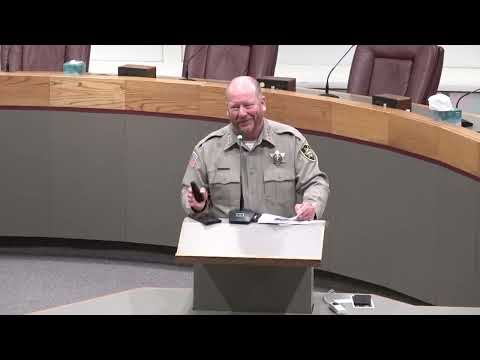
Sheriff: Fentanyl, meth drive sharp rise in Spokane County overdoses; naloxone use rises
Loading...
Summary
Sheriff Knowles told a community mapping session that fentanyl and methamphetamine now account for the vast majority of drug-related deaths and seizures in Spokane County, that first-responder overdose calls and naloxone deployments have surged, and that law enforcement and public-health partners are pursuing better data and coordination.
Sheriff Knowles told a Spokane community mapping session that first responders dispatched to drug-related calls in the county “have quadrupled in the last 3 years from 2022 to 2024,” and that calls requesting naloxone increased about fivefold in the same period.
The sheriff said the Raven task force and other county analyses show fentanyl and methamphetamine are the dominant drivers of overdose deaths in 2024. “Fentanyl and methamphetamine either individually or collectively comprise 95 percent of the 332 Spokane County adjusted drug related deaths in 2024,” he said, citing Raven’s report and data from the Spokane County coroner’s office.
Why it matters: the sheriff framed the trend as a rising operational burden on police, fire and emergency medical services and a public-health crisis that cannot be addressed by one tool alone. He noted that naloxone saves lives — “the fact of the matter is somebody’s alive” — but that naloxone only treats opioid overdoses and does not reverse overdoses involving methamphetamine or cocaine.
Most important facts from the presentation: the sheriff said a county CAD-derived count showed about 4,039 overdose calls for service in 2024 — “do the math, it’s 100 a day” — and roughly 2,100 calls specifically involving requests for naloxone. He also cited coroner figures (presented as part of the Raven report) that listed 272 fentanyl deaths, 44 methamphetamine deaths and 16 classified as other in a snapshot of 2024, and said that poly-drug use (combinations of fentanyl, methamphetamine and cocaine) was common.
On seizures and supply, the sheriff said local law enforcement counted 73,448 fentanyl pills in Sheriff’s Office/Valley seizures but that pill counts understate the scale because officers often avoid breaking sealed containers for safety. He also cited a Raven/HIDTA slide showing larger totals produced by multiagency reporting: “we seized almost 5.5 kilos of fentanyl powder, 200,000 fentanyl tablets and 141 kilos of methamphetamine” in 2024, figures drawn from Northwest HIDTA reporting he displayed.
Sheriff Knowles described a shift in forms of fentanyl seized: earlier in 2024 most local seizures were tablets, but by the second half of 2024 “almost 65 percent of our seizures were in powder form.” He said powder seizures present different risks and processing issues for both enforcement and public safety.
The sheriff also summarized drug-price data that he said came from Northwest HIDTA: median prices cited in the presentation included about $38.80 per gram for cocaine, $52.91 per gram for fentanyl powder, about $2 per fentanyl tablet on average, and roughly $5.29 per gram for methamphetamine. He said falling retail prices for fentanyl are one reason availability and use have increased locally.
Data and limits: Knowles repeatedly cautioned that the figures are imperfect and sometimes inconsistent across sources. He said CAD and records-management systems do not always capture victim ages or call-type updates (for example, whether a case should be recorded as a death on arrival), which complicates trend analysis. He recommended improvements in how local agencies quantify seizures, report naloxone use, and integrate ODMAP/DEA regional data.
Next steps described in the presentation included continuing Raven/HIDTA partnerships, pursuing grant opportunities, improving naloxone reporting and integrating local medical examiner data with DEA overdose mapping.
No formal vote or policy decision was taken at the session; the presentation was part of a community education and mapping exercise.