Get Full Government Meeting Transcripts, Videos, & Alerts Forever!
Get email alerts on the Education Differentiation topic
No spam. Unsubscribe anytime.
Granite superintendent highlights differentiated instruction after first grader builds world-flag display
Summary
During a visit to Lincoln Elementary, Superintendent Horsley showcased a first-grade student’s self-directed project assembling national flags and praised the teacher’s use of differentiation that let the student work ahead while keeping the rest of the class on task.
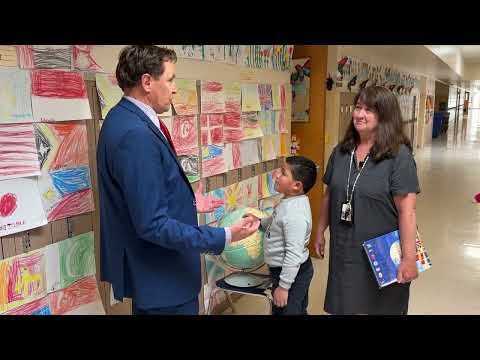
Superintendent Horsley visited Lincoln Elementary during a school visit and highlighted a first-grade classroom project in which a student, Santiago, created a large display of national flags after developing a strong interest in maps.
The visit underscored how classroom differentiation allowed the student to pursue advanced interests without disrupting instruction for classmates. "I just thought this was an incredible example of looking at some of the challenges we experience and, finding differenti- differentiation and ways to help expand the young minds," Superintendent Horsley said.
Lisa Heath, a first-grade teacher at Lincoln Elementary, told Horsley that the unit began in February when the class studied maps and where students live. "I checked out an atlas from the library for him, and he has used this every day," Heath said, describing how Santiago used the atlas to identify countries and produce flags for the classroom wall.
Heath described the classroom routine she developed: Santiago proves he understands the current lesson, then is allowed to work ahead. "I've allowed him to work ahead of us and then I just check it. And if he's good to go, then he takes his atlas and he goes to the back table with his supplies and will make the flag and stuff," Heath said.
Horsley and Heath pointed to a concrete example of peer inclusion that resulted from the project: a second grader could not find the flag for his home country, so Santiago drew and labeled the missing flag and added it to the Africa section of the display. Heath quoted the second grader saying, "Thank you so much for putting my flag up there." Horsley said the exchange illustrated how the individualized project also benefited classmates.
Heath also noted that Santiago had recently turned 7. During the visit Horsley walked the hallway display with Santiago and asked about specific flags; Heath recounted that Santiago could identify flags even when names were covered.
The visit concluded with Horsley thanking Heath for her work with students and wishing them a good summer. "We appreciate you," Horsley said.
The session was presented as an in-classroom demonstration of differentiated instruction and did not include any formal board actions or policy changes.