Get Full Government Meeting Transcripts, Videos, & Alerts Forever!
Get email alerts on the Budget Exceptions topic
No spam. Unsubscribe anytime.
Committee hears briefing on $1.8 million in 2024 budget exceptions; IT delays, pensionable claims cited
Summary
Seattle's Finance Committee received a briefing May 21 on a council ordinance seeking $1.8 million in retroactive adjustments to the 2024 budget, citing $1.1 million for industrial insurance pensionable claims and $658,000 for unanticipated law-department costs tied to an IT transition and payroll system issues.
Seattle's Finance, Native Communities and Tribal Governments Committee on May 21 received a briefing on an exceptions ordinance that would retroactively add $1.8 million to the city's 2024 budget.
Ben Noble, director of central staff, told the committee the request takes two forms: a $1.1 million increase to the industrial insurance fund managed for payroll-bearing departments to cover large, pensionable injury claims, and $658,000 for the Law Department to cover unanticipated costs tied to a delayed criminal case management system and Workday implementation issues.
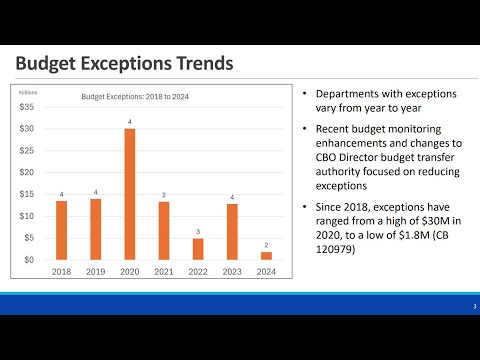
The exceptions ordinance would amend Ordinance 01/6955, the ordinance that adopted the 2024 budget and the 2024–2029 Capital Improvement Program. Noble and Tom Meiksel of council central staff framed the request as a routine, after-the-fact cleanup step: Meiksel said, "this is the smallest exceptions bill in the history, in the history that we've been tracking." The presenters and committee members noted the city has seen a downward trend in the number and dollar amount of exceptions in recent years.
Why it matters: Exceptions formally increase last year's adopted budget to reflect costs that exceeded departmental authority. The committee was told the industrial insurance request responds to unpredictable, high-cost pensionable claims for employees who cannot return to work. The law-department request reflects extra licensing, personnel and transition costs after implementation delays. Vice Chair Rivera questioned whether the industrial-insurance charge is collected centrally; Noble explained it is a citywide charge assessed to payroll-bearing departments and pooled in an industrial insurance fund that the City Budget Office forecasts and manages.
Committee members pressed for accountability and follow-up. Noble and Meiksel said the Budget Office has stepped up budget-to-actual monitoring under a fiscal-transparency program and that the Law Department and Budget Office agreed to more regular check-ins to avoid repeat exceptions. Council member Kettle noted that the Seattle Municipal Court's case-management system was up and that the remaining data-exchange issues reported earlier appear to be fixed.
Next steps: Central staff said the exceptions ordinance requires a three-quarter council vote for adoption. Central staff scheduled a second briefing and possible vote in the Select Budget Committee on June 4, with a final vote on the full council docket on June 10.
The item was a briefing; the committee took no vote on May 21.