Get Full Government Meeting Transcripts, Videos, & Alerts Forever!
Get email alerts on the Air Quality Permitting topic
No spam. Unsubscribe anytime.
Air regulators: nonattainment rules and offsets constrain siting of large on‑site generation; 15 companies have approached Utah
Summary
Utah Division of Air Quality told the interim committee 15 companies have sought pre‑application discussions about on‑site generation or new power projects; regulators warned that nonattainment rules, offsets and permitting tests shape where and how projects can be built.
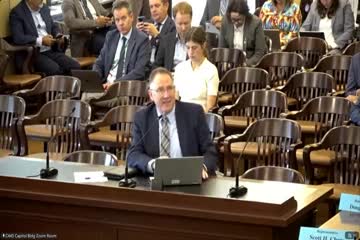
Bryce Bird, director of the Utah Division of Air Quality, told the committee that over the past six months the division has been approached by 15 companies considering on‑site generation or new electrical generation projects in Utah. "In the past 6 months, we—ve had 15 companies approach us with either on‑site generation or, new electrical generation development," Bird said.
Bird explained that where projects can be sited in the state, and how quickly they can be permitted, depends on air quality classifications and federal limits. Areas near the Wasatch Front and the Uinta Basin are designated nonattainment for pollutants such as PM2.5 and ozone; those designations lower permitting thresholds for major sources and require emissions offsets, additional monitoring and more detailed modeling before permits can be issued. Bird said that the state has created online mapping tools to help applicants understand where emissions sources and nonattainment areas are located and encouraged pre‑application engagement so staff and applicants can prepare complete applications.
On timing, Bird said the division is averaging roughly 120–130 days to issue a permit after a complete application is filed, but projects subject to major source review or additional monitoring can face much longer timelines. He emphasized that the division requires applicants to demonstrate the use of best available control technology and to quantify emissions, and that in nonattainment areas applicants must obtain emission offsets — either by reducing other emissions or by purchasing emissions credits.
Committee members asked whether the pre‑application inquiries were for natural gas, diesel or nuclear. Bird said most inquiries were for on‑site fossil generation — natural gas or diesel used to meet large data‑center loads — and that the difficulty of meeting nonattainment limits was prompting some companies to consider locations off the Wasatch Front. "A lot of them have have started looking at areas off the Wasatch Front," Bird said, citing latency constraints for data centers and the need to be within about 100 miles of trunk fiber while also avoiding air‑quality constraints.
Bird and other regulators said they are focused on streamlining permitting timelines where possible and on early engagement with potential applicants, but they cautioned that statutory federal clean‑air requirements constrain how permits can be issued.