Get AI Briefings, Transcripts & Alerts on Local & National Government Meetings — Forever.
Senate committee hears wide-ranging testimony on bill to limit court-ordered reunification "therapy"
Loading...
Summary
Senate committee members heard hours of testimony on House Bill 3783, a proposal to restrict certain court-ordered "reunification" or intensive family therapy practices that supporters say can isolate children from custodial parents and opponents say could strip courts of needed tools.
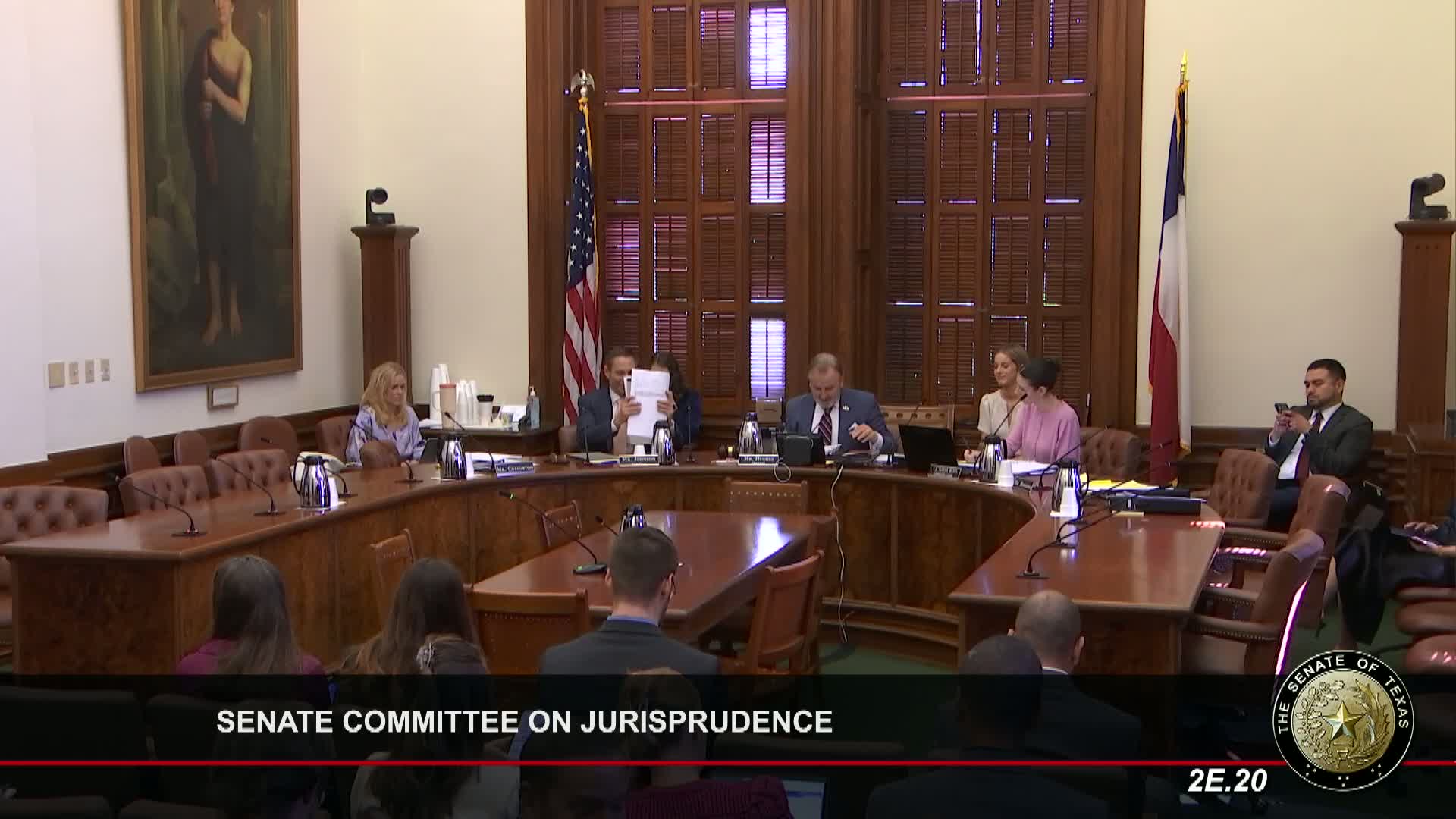
The Texas Senate Committee on Jurisprudence took testimony on House Bill 3783 on May 7, 2025, a bill that would restrict certain kinds of court-ordered counseling often described in testimony as "reunification therapy." Proponents said the bill would prevent coercive, unregulated programs that isolate children from safe parents; opponents warned the bill in its current form could strip courts of necessary tools to address severe parental alienation and psychological harm to children.
Senator Parker, the bill's sponsor, told the committee the legislation does not ban all court-ordered family therapy but would prohibit practices that, supporters said, remove children from their custodial parent or use coercion and unregulated private transporters. "This bill simply places legal guardrails around this practice, particularly by banning forced separation from the primary custodial parent," Parker said while laying out the measure.
Several people who said they had direct experience with intensive reunification interventions testified in favor of the bill. Jeff Diamond, an attorney and adoptive father, described his daughters' experience and called the programs "a symbolic experimental intervention" in the words used in materials from some providers. Abigail O'Brien, who said she and her brother were put through a program and subjected to an extended "no contact" order, told senators the experience was coercive and traumatic. "No child should ever be forced to choose between safety and a relationship with the parent," O'Brien said.
Advocates for victims of domestic violence supported the bill. Jen Mudge, public policy manager for the Texas Council on Family Violence, said family therapy is effective only when participants can speak honestly and that "forcing a victim to be in the same room in a counseling session with an abusive partner . . . increases the risk of violence."
Opponents included licensed clinicians and some family-law practitioners who said the bill's language is overbroad and would remove a judge's ability to order and allocate payment for ordinary family counseling. Judge Carl Hayes, of Hays County family court, told the committee he is concerned that language on the first page removes a court's authority to order a party to pay for counseling at all, which would prevent judges from requiring therapeutic interventions that a court finds necessary. "We're throwing the baby out with the bathwater," Hayes testified, urging the committee to restore limited authority to order payment and to narrow the bill's scope.
Other witnesses raised technical and equity concerns. Several speakers said the bill's use of the phrase "credible evidence" invoked an evidentiary standard that is not defined and could invite litigation about threshold findings in interim hearings; some suggested replacing the bill's family-violence reference point with the Family Code's established definitions (Family Code 261.001). Military advocates told the committee the measure as drafted could create unintended consequences for service members who live out of state or must travel for court-ordered interventions.
Clinicians who provide reunification services said many families they treated benefited from structured programs designed to safely reintegrate an estranged parent, and they warned a blanket ban could harm children who need therapeutic support during reunification. Lisa Wellens, a licensed clinical social worker with decades of court experience, said the practice has often been used to repair relationships after prolonged separation and that courts and clinicians should be allowed to use evidence-based interventions in appropriate cases.
Committee members asked detailed questions about the bill's language, including whether it should explicitly reference statutory abuse definitions, how to preserve judicial discretion while protecting victims, and whether the bill should add a safety carve-out allowing the court to authorize narrowly tailored interventions to protect a child's well-being. Multiple witnesses proposed specific edits: restore the court's limited authority to order payment for counseling; clarify the evidentiary threshold; and reference Family Code 261.001 for the definition of abuse.
Action: The committee took public testimony from scores of witnesses on both sides, heard invited experts and family members, and left the bill pending for further drafting and consideration.