Get Full Government Meeting Transcripts, Videos, & Alerts Forever!
Get email alerts on the Child Support Interest topic
No spam. Unsubscribe anytime.
Senate committee considers lowering interest on overdue child support to fixed 5%
Summary
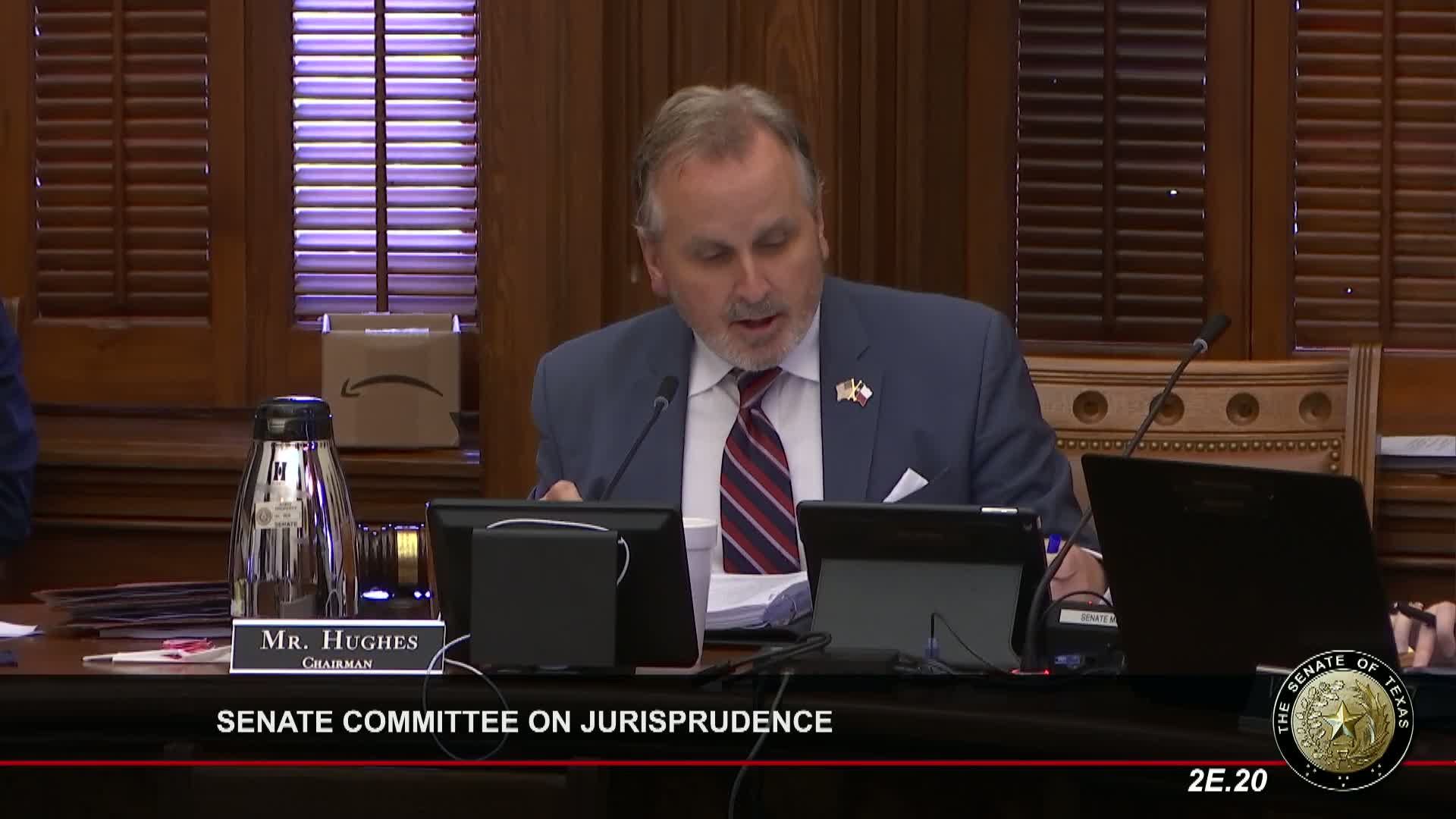
The Texas Senate Committee on Jurisprudence heard testimony on House Bill 4213 on May 7, 2025, a bill that would fix the interest rate on overdue child support at 5 percent and require the Office of the Attorney General to report metrics on the change.
The Texas Senate Committee on Jurisprudence heard testimony on House Bill 4213 on May 7, 2025, a measure that would change how interest accrues on overdue child support and require the Office of the Attorney General to report on the change.
The bill as filed would replace a variable interest calculation tied to the prime rate with a fixed annual rate of 5 percent for child support arrearages. The committee substitute described to the panel would make that change and require the Office of the Attorney General to include metrics about the effect of the lower interest rate in its biannual child-support enforcement report.
Dean Zaffirini, presenting the bill for the Senate, said the measure was intended to address the difficulty many families face when pursuing overdue support and to improve collection from low-income obligors. "This high interest rate compounds the debt, making it increasingly difficult for low-income parents to catch up on missed payments," the Dean said while explaining the substitute.
Joel Rogers, Associate Deputy Attorney General for Child Support Legal Services, told the committee the attorney general's office has operational concerns with variable and compound interest language. Rogers said the office's new case-management system was designed to handle a simple fixed interest rate and that variable or compound rates would require substantial reprogramming that likely could not be implemented by Jan. 1, 2026. "Anything that involves variable interest rates or . . . compound interest . . . is going to create a lot of confusion around the state," Rogers testified.
Witnesses were split. Terrence Champagne, who said he had testified previously on a companion Senate bill, said empirical work from Wisconsin suggested lowering high arrearage interest rates increased the probability that obligors paid down debt and made current payments. Champagne described Texas's arrears problem in testimony and supported the 5 percent substitute.
Cheryl Johnson, a former Galveston County tax assessor-collector testifying as a citizen, opposed the change. She argued that lowering the rate could "de-incentivize" payment and told the committee, "Please vote down this bill." Andrew Ross, an attorney representing clients who collect child support, also opposed reductions from 6 percent, saying in his view high interest rates deter nonpayment and help protect women and children who are judgment creditors.
Judge Carl Hayes, who said he has extensive family-court experience, supported the substitute and cited studies he described from Wisconsin indicating that lowering interest helped increase current collections. Hayes also noted the substitute includes a reporting requirement so the Attorney General must measure whether the change improves collections.
Committee members questioned witnesses about the empirical evidence and whether a 1 percentage-point change would have the behavioral effect seen in Wisconsin when that state cut much higher rates. Rogers reiterated operational constraints and asked the committee to adopt a simple fixed rate if it moved forward.
Action: The committee laid out the committee substitute, took public testimony, then closed testimony and left the bill pending for further consideration.
The bill's supporters argued a lower fixed rate could make it easier for low-income obligors to get out of arrears and pay current support; opponents warned a lower rate could reduce the incentive to pay and said the state should rely on data before changing the structure. The substitute requires biannual reporting by the Attorney General so the legislature will receive metrics on the law's effect if enacted.