Get Full Government Meeting Transcripts, Videos, & Alerts Forever!
Get email alerts on the Wildlife Protection Wind Siting topic
No spam. Unsubscribe anytime.
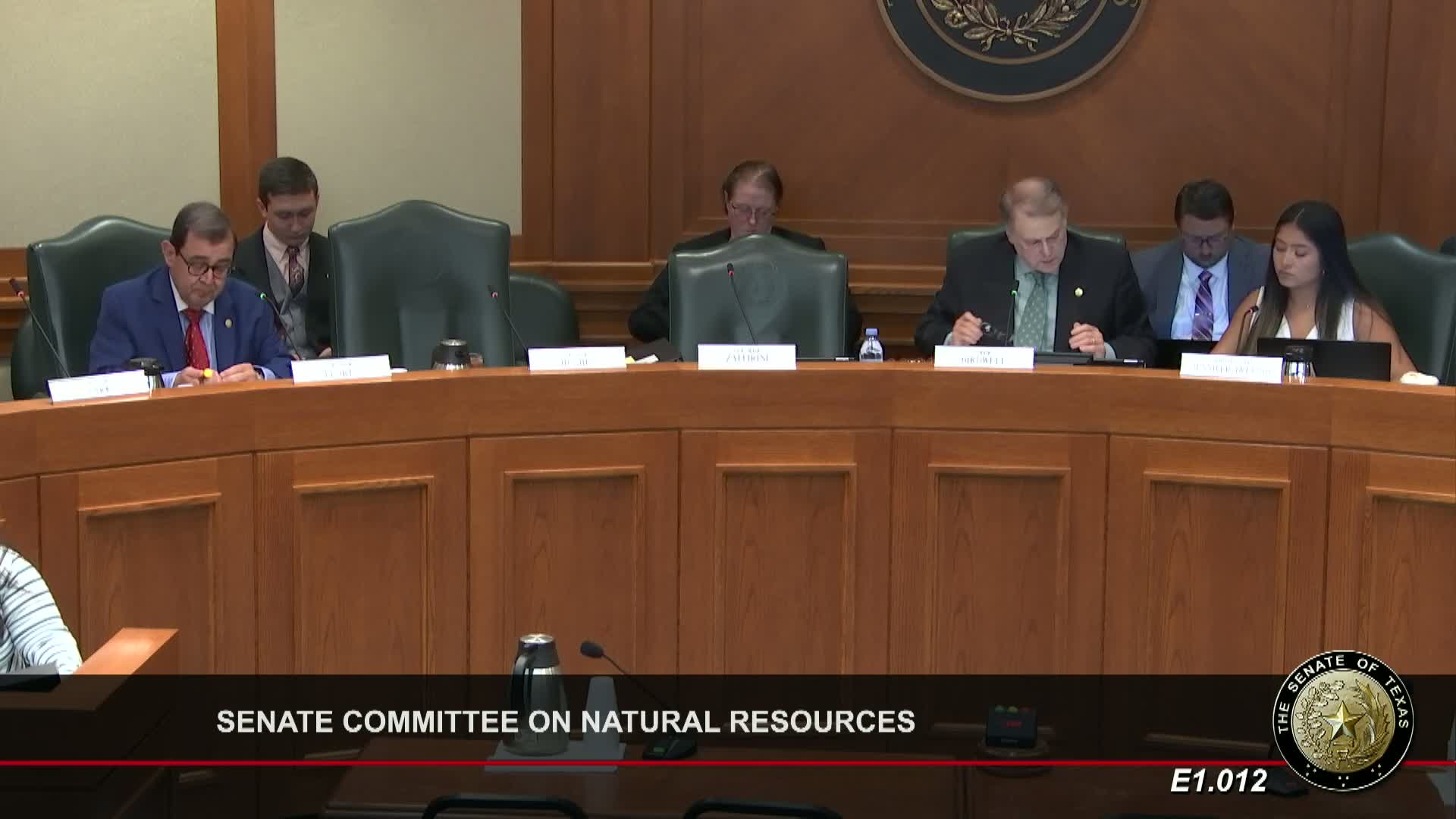
Committee hears bill to require TPWD review, 90‑day notice for structures over 500 feet on Gulf Coast
Summary
The Senate Committee on Natural Resources heard testimony on House Bill 3,556, a committee substitute that would require a 90‑day notice to the Texas Parks and Wildlife Department and give the agency a limited right to seek injunctive relief when proposed structures over 500 feet could materially harm migratory birds along the Texas Gulf Coast.
The Senate Committee on Natural Resources heard testimony on House Bill 3,556 on a measure that would require people in affected counties to notify the Texas Parks and Wildlife Department 90 days before constructing a structure taller than 500 feet.
The bill’s sponsor, Senator Lois Middleton, said the measure is intended to balance development with protection for migratory birds that use the Texas coast. "The Texas Coast is part of migratory flyways for more than 400 species," Middleton said while explaining the committee substitute.
The committee substitute preserves a 90‑day notice period to TPWD, then gives the department 45 days to review and recommend mitigation. If a developer declines mitigation, TPWD would have a further 45 days to file suit to limit or stop construction when the department finds the mitigation insufficient to prevent material harm. Middleton said the substitute limits the measure to structures over 500 feet and exempts counties with population above 500,000 or a city over 300,000.
Laura Zebihazy, Texas Parks and Wildlife Department ecological and environmental planning program director, testified as a resource witness and described how TPWD currently provides voluntary recommendations under Parks and Wildlife Code 12.0011. "At this time, Parks and Wildlife code 12.0011 gives us the charge to provide recommendations or technical guidance ... and we very rarely have feedback from those project developers," Zebihazy said, adding that there is no current enforcement mechanism to ensure developers implement recommendations.
Conservation groups and wildlife experts broadly supported the bill. Justin Driver Bliss, chief executive officer of the Texas Wildlife Association, said the measure is a "common sense approach" that would create a feedback loop for TPWD. Carter Crouch of the International Crane Foundation highlighted studies showing whooping cranes avoid turbines and said avoidance can cause "functional habitat loss." David Neustadt of the Coastal Bend Bays and Estuaries Program said radar and tracking data show the Gulf Coast is a hotspot for avian migration and cautioned existing mortality estimates may undercount impacts in this region.
Opponents urged narrower geographic limits and objected to the new authority that would allow TPWD to seek injunctive relief. Cyrus Reed, Lone Star chapter director for the Sierra Club, said the measure as substituted could give a single agency the ability to stop projects on private land and recommended a distance‑based limit (for example, miles from refuges) rather than county‑based coverage. Industry representatives including Chris Kirby of the Advanced Power Alliance said the substitute reintroduces "broad authority to block projects with no objective substantive legal standards" and warned it invites litigation unless additional guardrails—such as bond posting—are added.
Testimony spanned conservation organizations, former federal wildlife staff, researchers and industry representatives; the committee left the bill pending and did not vote. Senator Middleton said the substitute was worked with the lieutenant governor’s office and that she deferred treatment of the House speaker’s status to the House.
The committee also noted that the substitute narrows the conflict‑of‑interest provision to second‑degree relationships for elected officials and restricts legislator communications to permits within their districts.