Get Full Government Meeting Transcripts, Videos, & Alerts Forever!
Get email alerts on the Wildlife Management Beavers topic
No spam. Unsubscribe anytime.
Senate committee sends beaver-protection bill to floor after split vote
Summary
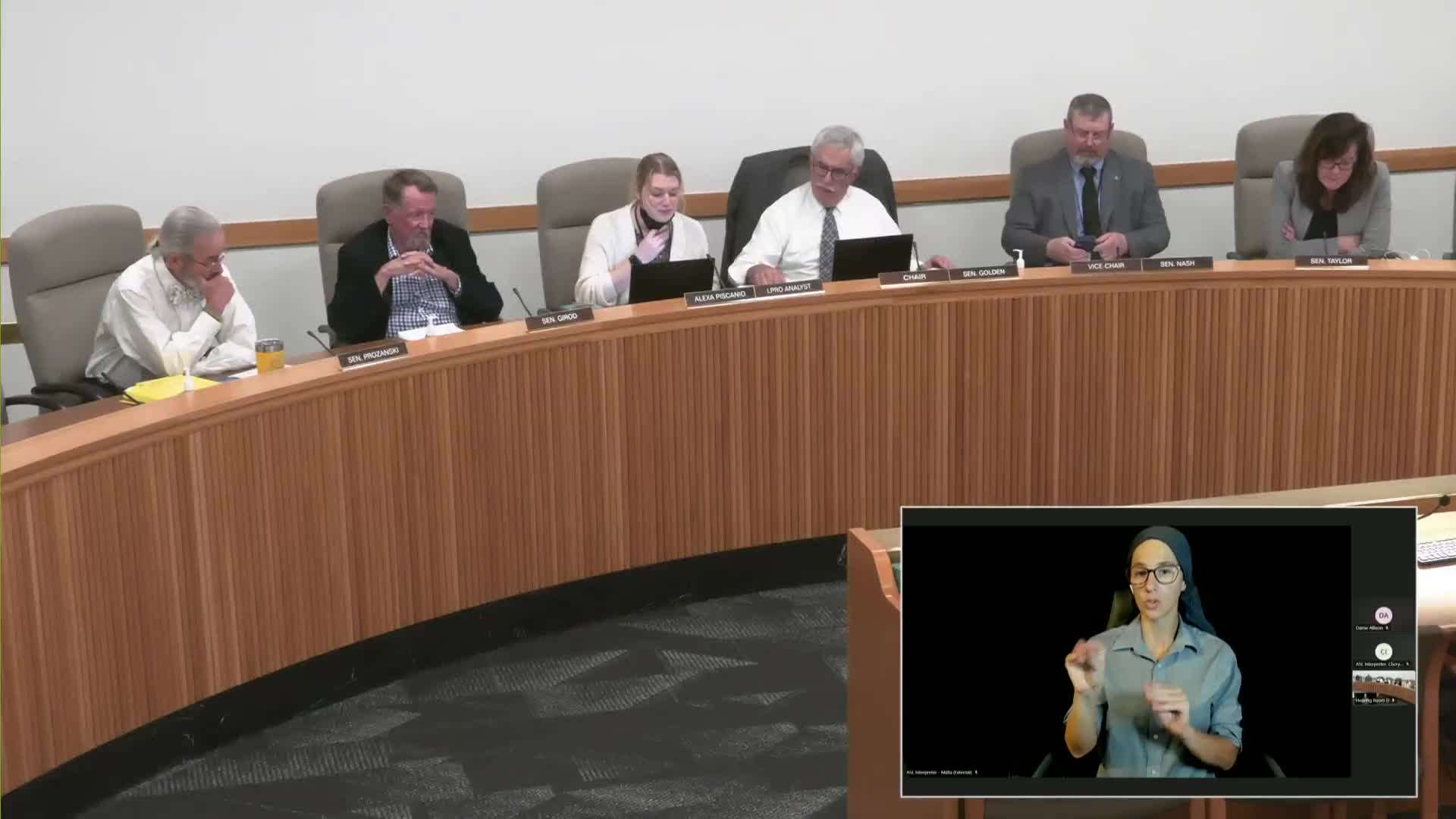
The Senate Committee on Natural Resources and Wildfire voted 3-2 on May 20, 2025, to advance House Bill 3932a, which would prohibit taking beavers in designated areas, require a state map of those areas, and preserve tribal harvest rights while allowing limited agency takings with authorization.
On May 20, 2025, the Senate Committee on Natural Resources and Wildfire voted 3-2 to advance House Bill 3932a to the Senate floor with a “do pass” recommendation.
The bill “prohibits the taking of beavers in designated areas and requires the Department of Fish and Wildlife to publish a map identifying these areas,” committee staff member Alexa summarized during the committee’s work session. Alexa said the measure also allows federal or state land-management agency employees to take beavers only “when necessary to address damage or an imminent threat to infrastructure, agricultural crops, or private property adjacent to public lands only with authorization from the Department of Fish and Wildlife,” and that the bill “does not supersede the rights of federally recognized tribes nor does it interfere with tribal harvest activities or cooperative management agreements between tribes and ODFW.”
The committee heard descriptions of three amendments posted to the Oregon Legislative Information System (OLISS). According to the staff summary, the A4 amendment would direct the Oregon Department of Fish and Wildlife (ODFW) to partner with conservation groups and licensed trappers to reintroduce and protect beavers in key habitats, including managing predators to support beaver populations. The A5 and A6 amendments would require rulemaking, mapping of permissible trapping areas, and periodic assessments; the A6 also adds a stated sunset clause of “02/1946” unless further action is taken, per the posted amendment text.
Senator Sherry said she would vote no and raised concerns about the legislature taking on management functions she said are typically handled by ODFW staff. “I’m going to be a no on this. I have several concerns. 1 of which is we as legislators taking a position of management of a species that has been under the purview of ODF and W. They’re staffed with biologists that understand the species, understand the landscape,” she said, adding that some river stretches in her community have been closed to trapping for decades without recruitment of beavers.
Chair Golding, chair of the Senate Committee on Natural Resources and Wildfire, said she had reviewed House testimony and the posted amendments and praised changes made in the House that, in her view, narrowed the bill’s scope. She said the bill was narrowed “from applying to all public lands to only impaired waterways,” and that change, along with other provisions, reduced the portion of trapping affected “from 20 plus percent, I believe, to 4%.” She also noted the bill includes a mechanism for permits on adjacent private lands if beavers cause damage.
Vice Chair Nash, who the transcript records voting no, was acknowledged by the chair for centering the trapping community’s concerns during the process. The committee recorded votes as follows: Senator Pruzan Thiel — aye; Senator Taylor — aye; Chair Golding — aye; Vice Chair Nash — no; Senator Girov — no. The measure passed the committee by a 3-2 margin. Chair Golding said she will carry the measure to the Senate floor.
The session was a single-item work session on House Bill 3932a; committee members discussed both policy limits on agency authority and measures intended to concentrate protections on impaired waterways while preserving tribal harvest rights. The committee did not adopt further amendments during the session and forwarded the bill with the committee recommendation.
What happens next: the bill goes to the full Senate for consideration; the committee record shows the chair will carry the bill to the floor.