Get Full Government Meeting Transcripts, Videos, & Alerts Forever!
Get email alerts on the Estate Tax topic
No spam. Unsubscribe anytime.
House Revenue Committee hears estate tax options; LRO warns threshold, portability changes can materially affect revenue
Summary
Legislative Revenue Office staff briefed the House Committee on Revenue on May 20 about how changes to Oregon's estate tax exclusion, portability, and rate structure would affect state revenue, timing of receipts and administrative requirements.
The House Committee on Revenue on May 20 heard an informational briefing on estate tax policy options that could substantially change state revenue collections, the Legislative Revenue Office told lawmakers.
John Hart of the Legislative Revenue Office said the state's current estate tax includes a $1,000,000 exclusion and that changing that exclusion or indexing it for inflation would affect taxpayers across the distribution and change revenue materially. "If the threshold is increased by $100,000 that first $100,000 reduces revenue by about 5.7%," Hart said, noting each additional $100,000 produces smaller reductions.
The briefing matters because revenue from the estate tax does not flow to the state general fund immediately after a policy change. Hart said estate tax returns are due 12 months after a decedent's death, with an automatic six-month extension often used; in his modelling, roughly 35% of liability tied to deaths in a calendar year arrives in the first fiscal year after collection begins and about 65% arrives the following fiscal year. "So there's about a year-and-a-half to two-year lag in a policy change to the effect on the state general fund from the estate tax," Hart said.
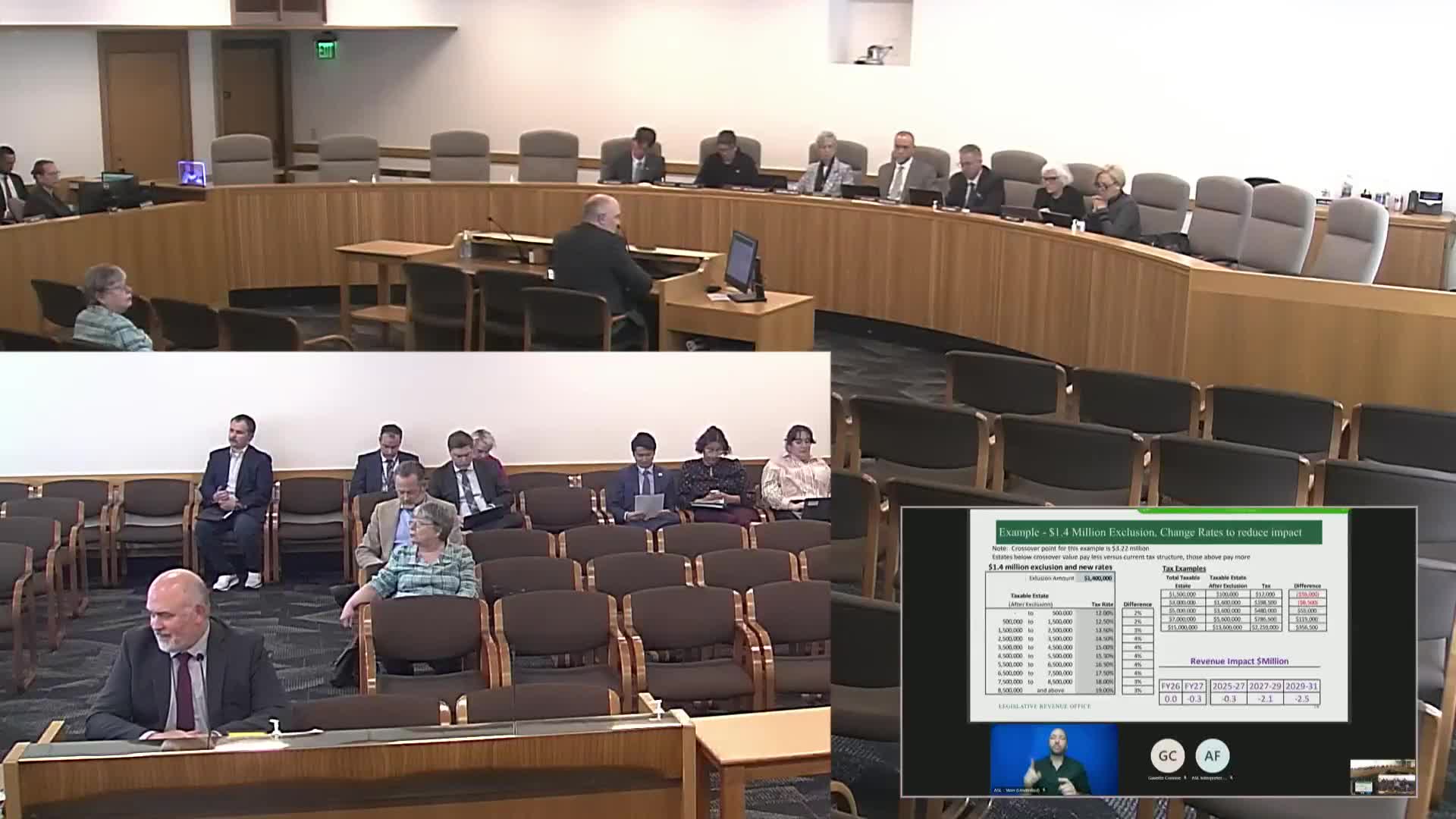
Hart presented examples: raising the exclusion to $1.4 million (approximately where the exclusion would be if it had been indexed since it was set in 2012) would reduce revenue by roughly 19% in his estimates. He showed how increasing the exclusion while raising rates to offset revenue losses produces a crossover point: with one example of higher rates, estates under about $3.22 million would pay less tax while larger estates would pay more; alternate bracket structures produced a similar crossover near $3.31 million.
Portability ' the ability of a surviving spouse to use an unused exclusion from a deceased spouse ' was another major focus. Hart explained two implementation options: prospective portability (applying at the death of the first spouse going forward) and retrospective portability (allowing surviving spouses who die after a date to use unused exclusions from earlier deaths). Hart warned each option phases in, in part because the surviving spouse's average life expectancy after the first death is about 10 to 12 years, and because filing and valuation rules affect when unused exclusions are claimed. "The requirement to file to disclose the unused exclusion amount'those are the reasons these have kind of steep phase-ins," Hart said.
Committee members asked about the forecast underlying the revenue estimates. Hart said the Office of Economic Analysis increased its estate tax forecast substantially for the May forecast and that previous estimates would scale proportionally. "Recent payments have been above trend," he said, but he deferred detailed questions about the forecast methodology to the Office of Economic Analysis.
Members also pressed administrative questions about portability and how assets passing to a surviving spouse or to children would use the exclusion. Hart cautioned some hypotheticals touched on legal issues that may require Legislative Counsel to clarify.
The committee received additional examples showing how changing the exclusion and adjusting rates affects individual estates at different sizes. Hart emphasized the illustrative nature of bracket and rate changes, saying there was "no express or implied warranty that this is the right way to increase those rates" and that the examples were to show revenue and distributional effects.
Next steps: Hart and Legislative Revenue Office staff offered to return with more detail on forecast changes and to set up a follow-up meeting with Legislative Counsel to address legal questions raised during hypotheticals.
The informational meeting drew questions from Representative Marsh, Representative Raschke and others and closed after committee members planned further review of the examples and assumptions.