Get Full Government Meeting Transcripts, Videos, & Alerts Forever!
Get email alerts on the Medical Cannabis Regulation topic
No spam. Unsubscribe anytime.
Nebraska senators debate how to implement medical cannabis; commission, enforcement and access divide lawmakers
Summary
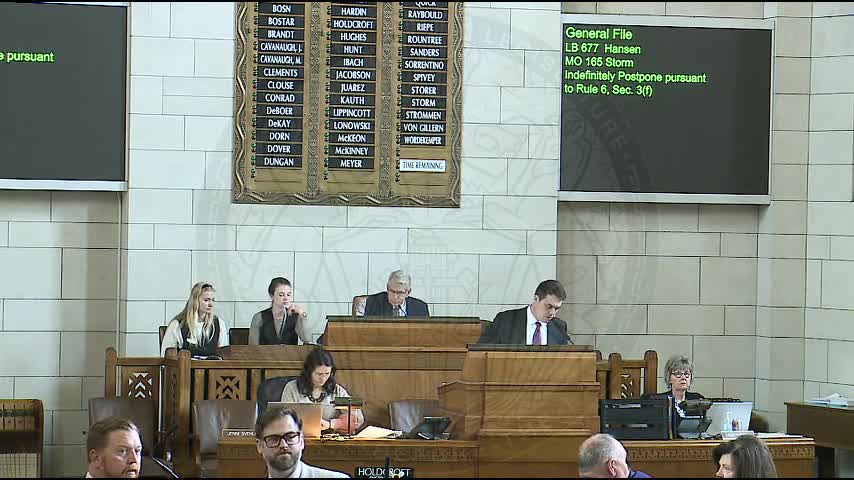
The Legislature spent hours debating LB677 and AM1251, a bill and committee amendment to implement the medical cannabis initiatives. Lawmakers clashed over whether the Legislature should set rules now or leave them to the new Nebraska Medical Cannabis Commission, and several formal motions to kill or accelerate the bill failed.
Lincoln — Nebraska senators spent the afternoon debating LB677 and a 122‑page committee amendment (AM1251) that would implement the medical cannabis measures voters approved last year, centering the fight on who should write rules and how tightly to restrict access.
Supporters of the bill, led on the floor by sponsor Senator John Hansen, said AM1251 is a narrow, regulated approach that protects patients and public safety while giving doctors and dispensaries clear guardrails. "This is a very restrictive, safe approach to get medical cannabis into the right hands of the right people," Hansen said on the floor.
Opponents, led by Senator Mark Storm, argued the ballot initiatives themselves gave primary regulatory authority to a newly created Nebraska Medical Cannabis Commission and that the Legislature should not pre‑empt or substantially alter the voters’ design. "The legislative branch, including voters through ballot initiatives, has wide discretion on the level of detail needed in setting standards," Storm told colleagues as he urged delay.
The committee that handled the bill, General Affairs, adopted AM1251 on a 5–3 committee vote and sent the measure to the floor. The amendment narrows the ballot initiative’s broad 5‑ounce possession allowance by specifying that no more than 2 ounces of that total may be in the form of dried flower, lists 15 qualifying medical conditions (from a Nebraska Medical Association review) and prohibits public smoking while allowing a set of non‑smoke medical delivery methods and seed‑to‑sale tracking and monitoring tied to the state prescription drug monitoring program.
Key points of debate
- Who writes rules: Several senators said the ballot language (Initiatives 4‑37/4‑38) vested regulatory authority in the Nebraska Medical Cannabis Commission; others argued the Legislature must pass statutory guardrails (taxes, licensing structure, carrier/caregiver rules) before the commission begins rulemaking. Proponents said AM1251 sets guardrails and taxes (a 5.5% point‑of‑sale tax directed to property‑tax relief) while forbidding smoking; opponents said preempting the commission would override the will of the voters.
- Enforcement capacity and public safety: Multiple senators cited law enforcement concerns, including a letter from the attorney general and statements by roughly 54 county sheriffs who raised enforcement and impaired‑driving challenges. Supporters said the bill strengthens enforcement tools by requiring seed‑to‑sale tracking, adding patient and caregiver registration, and integrating data into the state PDMP so law enforcement and clinicians can verify legally held medical product.
- Access vs. black market risk: Supporters warned that too‑restrictive rules would drive patients to out‑of‑state purchases or black‑market suppliers; opponents warned that looser rules — particularly for flower and delivery — would expand recreational use and complicate impaired‑driving and workplace safety enforcement.
Votes and formal actions
- A motion to indefinitely postpone LB677 (moved by Senator Storm) was put to the Senate early in the debate and failed: the motion to indefinitely postpone was not adopted (17 ayes, 20 nays on the voice/roll call reported on the floor). Senator Storm later moved to reconsider that vote; that reconsideration motion was not adopted.
- A later motion to bracket the bill until June 9 was offered and debated but not resolved before continued floor debate.
- Senate leaders later sought cloture on general file debate (a motion under Rule 7, §10 to end debate and proceed). That cloture motion failed on a roll call vote (23 ayes, 22 nays), leaving LB677 and AM1251 on general file for additional debate and amendment.
What AM1251 would do (committee summary and discussion points captured on the floor)
- Lists 15 qualifying medical conditions drawn from the Nebraska Medical Association and narrows the broad ballot language to defined diagnostic codes and treatment circumstances; requires a written recommendation from a licensed physician, osteopathic physician, physician assistant or nurse practitioner who primarily practices in Nebraska or has a documented 6‑month treating relationship.
- Keeps a statewide possession ceiling linked to the ballot initiative but limits dried flower to 2 ounces of the total; expressly prohibits public smoking and allows certain inhalation or vaporization methods for patients who cannot swallow medication.
- Establishes licensing and a 3‑tier supply chain (cultivation/processing/dispensary), a seed‑to‑sale tracking system, and integration with the prescription drug monitoring program to limit doctor‑shopping and duplication.
- Creates a licensing scheme discussed on the floor (vertical licenses and individual license caps were described in debate) and includes application fees and state oversight; it also allows municipal zoning and setback authority and sets penalties for noncompliance.
Outlook
After a day of extended floor debate and several formal motions, the bill remains on general file. Supporters signaled willingness to continue negotiating the amendment between general and select file, including the possibility of adjusting implementation dates and technical language. Opponents urged waiting for pending litigation tied to the ballot initiative and for the commission to finish initial rulemaking. With cloture not invoked, LB677 is expected to return to the floor for further amendments and debate in coming days.
The debate highlighted the tension between honoring voters’ initiative language and inserting legislative detail to govern licensing, taxation and enforcement — a split that will determine how Nebraska’s medical cannabis system opens and whom it serves.