Get Full Government Meeting Transcripts, Videos, & Alerts Forever!
Get email alerts on the Private Security Regulation topic
No spam. Unsubscribe anytime.
Senate Commerce advances two bills to tighten private security examiner rules, restructure fines and fees
Summary
The committee moved two measures related to private security examiners: a technical statutory update to meet federal background-check requirements and legislation restructuring the board's revenue model to replace fines with fees, accompanied by promises of stronger compliance work.
The Senate Committee on Commerce reported two bills related to the Louisiana State Board of Private Security Examiners favorably Wednesday, approving a technical statutory update and a separate measure to change how the board funds compliance work.
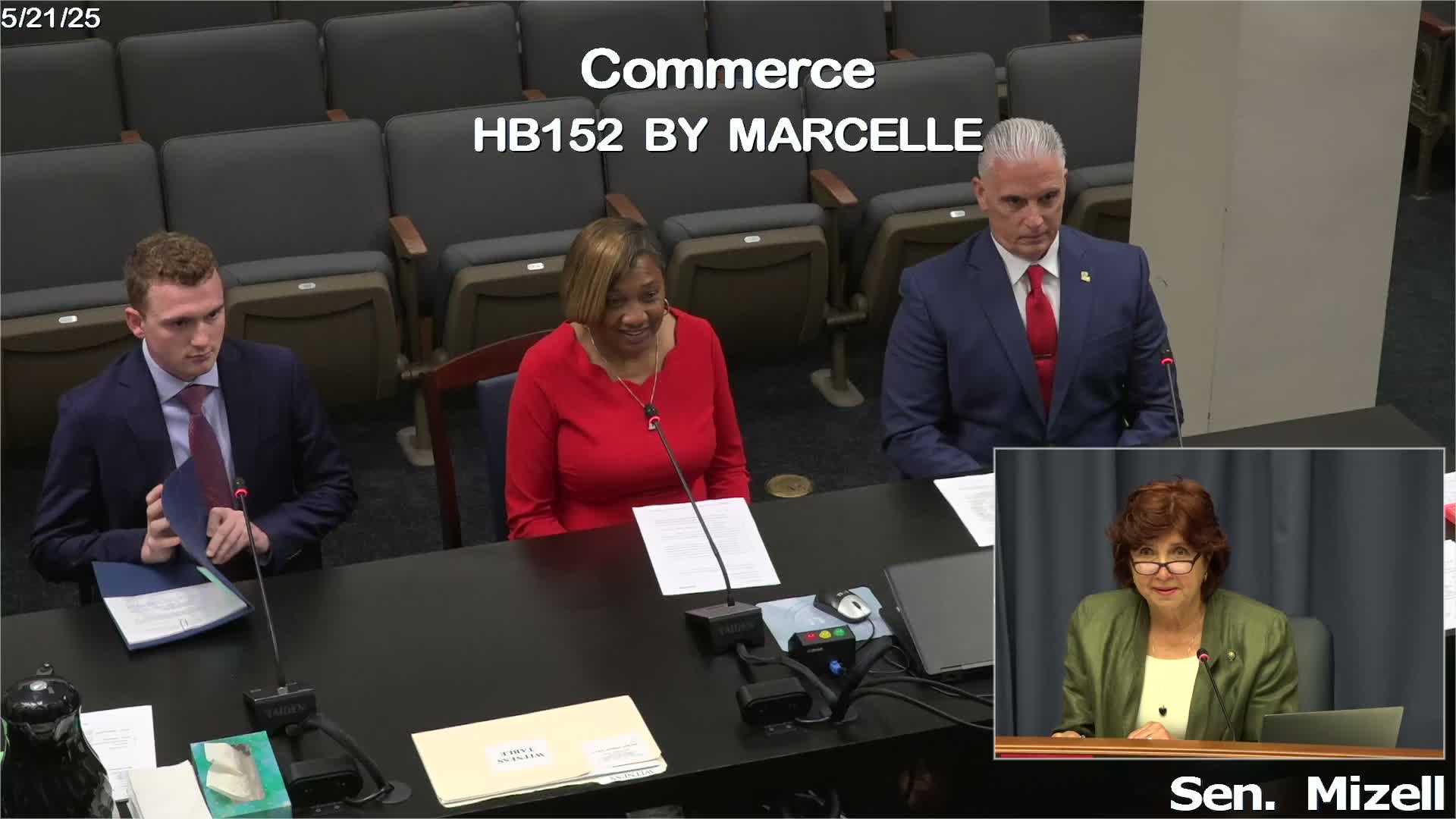
House Bill 152, described by witnesses as a federal-compliance technical fix, clarifies definitions for applicants, registrants and qualifying agents so the state can receive criminal background checks and other data under FBI CJIS rules. Carl Cezanne, executive director of the board, testified that the change responds to a federal audit and is intended to keep the board in compliance with background-check protocols. Senator Bowie moved the bill favorably as amended.
In a related matter, House Bill 157 would remove fines from the agency’s budget model and make up the difference through adjusted fees. Cezanne said the board commissioned a fee study and created a compliance unit to reduce the board’s reliance on fines. "It was my goal to get down to 0 fines," he said, describing new audit and compliance work and upgrades to the board’s licensing management system.
Witnesses told senators the board had not been audited comprehensively in decades and that prior operations lacked systematic compliance. The board’s director said reforms cut background-clearance times from several weeks to one to two days and that the board had audited every licensed company for the first time in 2023–24.
Senators asked how the board would enforce compliance without fines; Cezanne described a compliance unit, audits, and the rollout of a license-management system that will send advance notices of expiring documentation to reduce violations. The board also removed or reduced some one-time IT costs during negotiations, Cezanne said, to make the program more affordable.
Committee members moved both bills forward without recorded opposition after informational witnesses from the board and the Louisiana State Police described the technical needs and the planned compliance approach. The measures now advance to the Senate floor.