Get Full Government Meeting Transcripts, Videos, & Alerts Forever!
Get email alerts on the School Facilities topic
No spam. Unsubscribe anytime.
Facility study finds $118 million in needs; board approves Hollowell roof replacement
Summary
The Hatboro‑Horsham School District received a facilities feasibility and capacity briefing on May 19 that identified approximately $118,000,000 in recommended capital projects prioritized by safety, health and air‑quality.
The Hatboro‑Horsham School District received a facilities feasibility and capacity briefing on May 19 that identified approximately $118,000,000 in recommended capital projects prioritized by safety, health and air‑quality needs.
“Those findings really provided an identification of what the facility needs are going to be from 2024 through 2035,” the superintendent said while introducing CHA Consulting and the district’s architects. Jamie Lynch of CHA Consulting and the district’s staff reviewed prioritized projects, cost estimates and capacity findings.
Why it matters: the study frames multi‑year capital budgeting and potential debt decisions. The district’s current annual capital allocations typically range from about $3 million to $5 million; the study modeled a potential 10‑year plan that would require annual commitments in the $2.5 million to $9 million range to address the projects labeled serious and necessary.
Major findings presented - Total recommended projects: about $118,000,000 in today’s dollars. Major building estimates included roughly $65,700,000 for the high school, $33,700,000 for Simmons Elementary, and $15,200,000 for Blair Mill Elementary. Newer buildings such as Crooked Billet and Hollowell showed lower immediate needs. - PDE vs. functional capacity: Mr. Stone explained the district compared Pennsylvania Department of Education (PDE) “current use” capacity (a formula that multiplies full‑size classrooms by 30) with a functional‑use capacity that accounts for modern special‑education and small‑group spaces. That analysis showed Blair Mill, an older 1968 building, functionally exceeds capacity under the district’s program, while other newer schools have more flexible small‑group spaces. - Priority scoring and timing: CHA used a logic matrix scoring safety, health and air‑quality to set priority tiers; most critical projects identified in earlier phases have been addressed, with only about $200,000 of critical work remaining, the presenters said.
Financial and planning context The presentation emphasized that the $118 million estimate is a snapshot in current dollars and that construction inflation will raise costs if projects are delayed. The consultants provided an estimated renovation budget per building and noted a commonly used renovation benchmark: if recommended repairs exceed ~60% of an estimated full renovation cost, renovation may be worth deeper study. The high school’s recommended improvements measured near that benchmark (about 59.1% by the study’s summary), the presenters said.
Hollowell roof procurement and board action At the facilities committee report the board was told the Hollowell roof replacement procurement required corrective action: the low bidder, Procom Roofing, was found noncompliant with district policy 8‑26. The board rescinded the earlier award and voted to approve a new award to USA General Contracting Corporation for $2,338,000. The facilities committee noted the district previously allocated $2,900,000 in the capital budget for the Hollowell roof and that the district has secured $575,000 in grant funds toward the project.
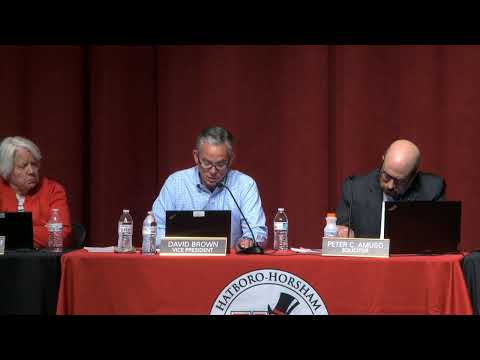
Board action on the agenda The board moved to approve facilities committee items 7A through 7E (which included rescinding the Procom award and awarding the Hollowell roof contract to USA General Contracting). The motion was moved by David Brown and seconded by Maggie Kistner; the board voted in favor of items 7A–7E.
Operational notes and follow up Presenters flagged site constraints at the bus garage (fueling and electrification limits) and noted the district continues routine capital investments each summer; the study does not obligate the district to complete any project. Mr. Stone stressed that any decision to pursue additional debt for renovations would require explicit financial planning because current debt service levels were already scheduled to remain near current levels through the next decade.
Ending Board members and staff said they will use the study as a baseline for multi‑year capital planning and continue to prioritize critical repairs while refining cost estimates and project timing.