Get Full Government Meeting Transcripts, Videos, & Alerts Forever!
Get email alerts on the School Finance topic
No spam. Unsubscribe anytime.
District financial advisor: Rowan County schools have about $19 million immediate bonding capacity
Summary
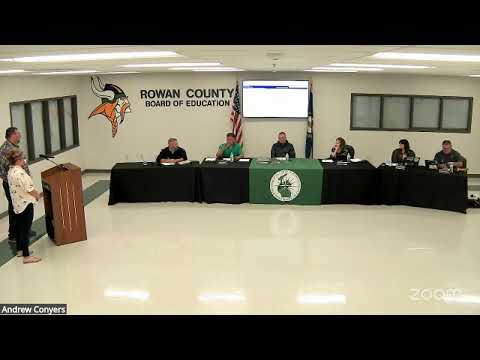
At a Rowan County Board of Education meeting, financial advisor Lincoln Diner of RSL Advisors presented a conservative estimate of the district’s maximum bonding capacity today at about $19 million, explained the revenue streams that support bonding and cautioned that near‑term debt payments limit additional borrowing until later years.
Lincoln Diner of RSL Advisors told the Rowan County Board of Education that the district’s maximum borrowing capacity under conservative assumptions is $19,000,000.
Diner, who presented a multi‑page handout and walked the board through current debt, revenue streams and how state support is matched, said the $19 million figure assumes current revenues and does not project future property‑value growth. "That number is $19,000,000 shown at the bottom of column c," he said while explaining the spreadsheet.
The presentation laid out how the district’s existing debt service (roughly $2.9 million per year for the next eight to nine years) interacts with recurring revenue sources. Diner identified those sources as the local five‑cents‑per‑$100 assessed value property tax ("the local nickel"), a previously levied second nickel, capital outlay tied to average daily attendance, and periodic state assistance from the School Facilities Construction Commission (SFCC). He said the nickel currently generates about $998,558 for the district and that the sum of the district’s revenue sources in his snapshot for fiscal 2026 is about $3,821,000.
Nut graf: The estimate matters because it defines what projects the district could finance now without changing tax rates or waiting for existing debt to decline. Diner emphasized the constraint that heavy near‑term payments place on issuing new bonds and noted that state offers through SFCC, made roughly every two years, can materially affect how much a district can build.
Diner described how SFCC awards work: the commission allocates a biennial pot to districts based on facility need and an equalization formula; the SFCC’s contribution to debt service can make some projects feasible that local revenue alone would not support. He pointed out one line in his spreadsheet showing the SFCC committing about $11,172 a year of debt service toward a hypothetical future project.
Diner cautioned board members about timing and interest‑rate risk. Using conservative interest assumptions, he said issuing $19 million today would produce the principal and interest schedule shown in his handout; if market rates rose before the district issued bonds, the district could face higher costs later. "If you did issue $19,000,000 today, the interest payments would be in column E," he said.
He also noted that a portion of the $19 million — roughly $950,000 in his calculation — is restricted by SFCC rules to priority 1 or 2 facility work, while the remainder may be used for other permitted projects.
Board members asked for clarifications about how forward projections would change the capacity estimate; Diner said he did not include future property‑value increases in the $19 million snapshot but that, historically, two‑year SFCC cycles and property growth can provide additional capacity over time. He added a conservative estimate that capacity could grow by roughly $3 million if conditions evolve as they have in recent cycles.
Ending: Diner offered to run alternative scenarios if the board specified targets or if the board wanted to reserve annual amounts for operations, maintenance or smaller capital items rather than using the full bonding capacity. "At any point, come to me with some targets," he said, offering to model different holdbacks and interest assumptions.