Get Full Government Meeting Transcripts, Videos, & Alerts Forever!
Get email alerts on the Economic Development Agriculture Parks topic
No spam. Unsubscribe anytime.
Council approves $309,000 ARPA match for JBS Urban Barn; asks staff to study additional bathroom funding
Summary
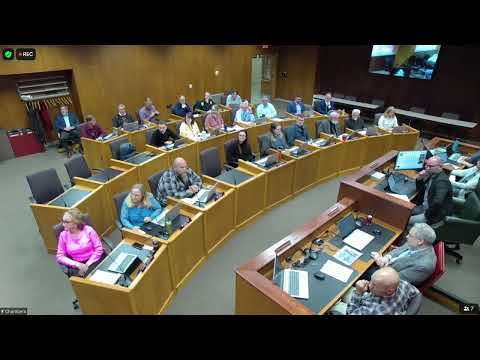
The Green Bay Common Council on May 20 authorized a $309,000 ARPA match to Wello’s JBS Urban Barn project to secure a federal RFSI grant match and directed staff to report back on costs and alternative funding for public restrooms after debate over reallocating ARPA site-acquisition funds.
The Green Bay Common Council on May 20 approved a $309,000 match from American Rescue Plan Act (ARPA) funds to Wello’s JBS Urban Barn project and directed city staff to return to the finance committee with cost estimates and possible funding sources for adding public restrooms.
The decision secures a time-sensitive match for a federal RFSI grant that Wello had won to support local food-system investments, city officials and project representatives said.
Wello Executive Director Natalie Bomstead told the council the JBS Urban Barn is intended to “support our local farmers” and that the organization “have already secured additional funding to ensure that the investment by the city is not only matched but exceeded in dollar amounts.” The project would provide shared equipment, processing capacity and other supports aimed at socially disadvantaged farmers who sell at local markets, Bomstead said.
Council debate centered on whether the ARPA allocation — originally earmarked for site acquisition for affordable housing — could be used to increase the city’s commitment to $750,000 so the project could include a public restroom facility adjacent to the planned destination playground. Alder Preston moved the $750,000 amendment; Alder Prophet seconded it. Director Dirk Ditscheit, speaking for city staff, said the council had scrapped a previously designed building that had come in at “over $4,000,000” and that the revised plan would need redesigning. Ditscheit said, “We’re estimating that the $750,000 would cover the cost to hire the architect and to build the barn as needed for Wello’s match in addition to adding public restrooms to it.”
Several council members raised legal and policy questions about using ARPA funds that were allocated for site acquisition, and others urged acting quickly so the RFSI grant match would not be lost. Alder Hinkfuss and Alder Grant pressed for a more detailed budget and for the matter to return to the finance committee for additional vetting; Alder Proffitt and others argued the funds could lapse if not committed.
After discussion, the council rejected the motion to increase the allocation to $750,000 and instead approved the original $309,000 commitment as presented to council, with an amendment directing staff to prepare a report for the finance committee: cost estimates for adding public restrooms and identification of possible additional funding sources. The motion to approve as amended was made by Alder Johnson and seconded by Alder Galvin; the item passed.
The council and staff discussed construction contingencies and past project experience. Ditscheit told the council the city typically budgets a contingency of about 15 percent and noted a comparable shelter project a decade earlier cost about $550,000. Staff also said the ARPA account balance available for reallocation was roughly $752,843, which informed the earlier $750,000 proposal.
Project supporters said the barn and equipment would create new revenue opportunities for farmers, help build culturally relevant education and training, and link economic development to housing stability. Wello representatives told council they had a list of about 50 farmers interested in participating.
The council forwarded the staff referral and the $309,000 match to allow the city to secure the federal grant match while staff returns with line-item estimates and funding options for restrooms.
The approval does not authorize construction beyond the $309,000 match; staff must report back with formal cost estimates and identified funding sources before any additional ARPA dollars are committed.