Get Full Government Meeting Transcripts, Videos, & Alerts Forever!
Get email alerts on the Vote Centers topic
No spam. Unsubscribe anytime.
Monroe County election board fails to adopt vote-center plan after amendment
Summary
After a public hearing with broad public support, the Monroe County Election Board approved an amendment removing named early-voting satellite sites but failed to adopt the final vote-center resolution when a required unanimous vote was not achieved.
The Monroe County Election Board on Oct. 11 failed to adopt a resolution to designate the county as a vote-center county after an amended plan passed the board but did not receive the unanimous approval the statute requires.
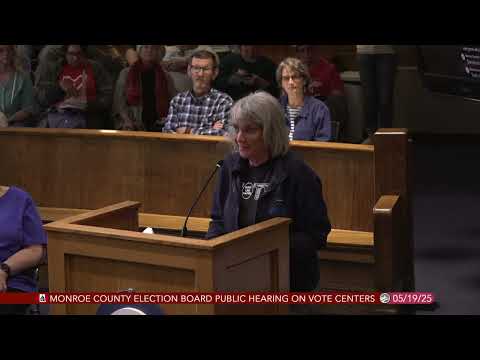
The vote followed a more than hourlong public hearing in which speakers — including county officials, members of the Vote Center Study Committee and dozens of residents — largely urged the board to adopt the proposed vote-center plan to reduce voter confusion and improve access. The board approved an amendment removing specific recommended early-voting satellite locations from the study committee’s report, but on a roll call the resolution to designate Monroe County as a vote-center county with 29 vote centers recorded two votes in favor and one opposed and failed to carry.
The amendment the board adopted deleted the committee’s specific location recommendations for additional satellite early-voting offices — named in the draft as Ellettsville Town Hall, the IU Center on Representative Government and the Monroe County Public Library Southwest branch — while keeping the committee’s broader recommendation that the clerk identify the county’s required early-voting site.
“The confusion about where to vote has led, unfortunately, in Monroe County to voters being turned away,” said Ami Gandhi, a nonpartisan member of the Vote Center Study Committee and a voting-rights attorney. “That has really made an impact on the committee’s work and analysis.”
Multiple commenters said vote centers would reduce provisional ballots and the number of voters who arrive at the wrong location on Election Day. “We will always have situations such as we did with Southside Christian Church last year…people were rerouted…didn’t get the message,” said Laramie Wilson, a longtime poll worker and Monroe County resident, who pressed the board to count the costs of expanded staffing, training and technical support in any rollout.
County leaders and fiscal officials who spoke said they could support the plan if the financial impacts were managed. “The committee answered my questions thoroughly and satisfactorily,” said Peter Iverson, president of the Monroe County personnel administration committee and president pro tem of the County Council, citing figures and multi‑cycle cost charts in the committee report.
Supporters cited the study committee’s unanimous recommendation — the committee voted 7‑0 on the plan — and pointed to survey results the election office summarized during the meeting: roughly 296 digital comments were recorded, of which the presenter said about 77% supported the change (about 224 responses), 17 wanted changes and 48 opposed it; roughly 64,000 postcards were mailed as outreach and about 300 responses were received, according to staff remarks.
Opposition at the hearing focused on cost, turnout evidence and the board’s role. “The goal of the election board is to run fair, cost‑effective, bipartisan elections,” said Mr. Shields (board member), who said his research did not show a clear turnout benefit from vote centers and voiced concern about adding equipment and operating costs. When the board proceeded to a roll-call vote on a resolution to adopt the plan as amended, Clerk Brown and Chair Fernandez voted yes and Shields voted no; the chair noted state rules require unanimous action for the filing, and the resolution failed.
Board members and staff also debated how the vote-center plan would interact with the county’s authority to add satellite early‑voting sites outside the plan. Several speakers, including members of the study committee and Clerk Brown, said the statute requires the designation of at least one early‑voting satellite office and that the election board could later add or amend additional satellite locations, but that amendments to a submitted plan would require unanimous board action.
Public commenters and committee members raised several operational concerns for any transition: ensuring adequate poll-worker staffing, expanded training, on‑site technical support at vote centers, and budgeting for Saturday early‑voting days in addition to the state‑mandated 28‑day early voting period. “Are we adequately staffing these poll centers?” Wilson asked the board, noting large Election Day turnouts at some current sites and the different personnel duties required at vote centers.
The board’s failure to adopt the resolution means the study committee’s recommended plan will not be filed with the state at this time. Board members said the matter may return to the board for further discussion; the next formal step for any future submission would be amendment and unanimous approval of a plan and then review by the County Council before state filing.
The hearing record included a mixture of resident testimony, formal committee presentations and written comments submitted electronically. The study committee’s draft remains available to the board as a reference for further action.