Get Full Government Meeting Transcripts, Videos, & Alerts Forever!
Get email alerts on the Open Meetings Law topic
No spam. Unsubscribe anytime.
County counsel reviews open‑meetings law: closed sessions, exemptions and walking quorums explained
Summary
Barron County’s corporation counsel reviewed Wisconsin’s open‑meetings law for supervisors, explaining statutory exemptions for closed sessions, notice requirements, the 12‑hour reconvening rule and risks of “walking quorums.”
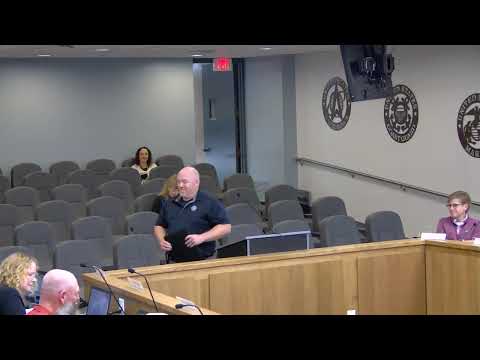
Barron County’s corporation counsel gave a detailed review of open‑meetings law at the May 19 county board meeting, outlining when boards may hold closed sessions and how members must conduct themselves to avoid violations.
Counsel advised that “meetings of governmental bodies are supposed to be held in open as much as possible,” and that the law provides limited statutory exemptions allowing closed sessions for discrete reasons such as employee disciplinary matters, competitive bargaining and consulting with legal counsel. Counsel repeatedly referenced Wisconsin Statutes §19.85(1) exemptions, including subsections (b), (c), (e), (f) and (g), and noted there are 11 statutory exemptions in total.
Counsel said the meeting must begin in open session and the presiding officer must announce the authority and subject matter for any closed session. “To go into closed session, you have to open the meeting must start in open session,” counsel said. The motion, second and the vote to enter closed session must be recorded in the minutes; once a body goes into closed session it generally may not reconvene in open session for 12 hours unless the original public notice stated an intent to return.
The counsel warned supervisors about “walking quorums,” where a series of smaller meetings or communications can amount to an unnoticeed meeting if a sufficient number of members collectively decide a course of action. He illustrated a “negative quorum” for budget amendments: while a quorum is 15 members for the county board, a two‑thirds vote to amend the budget requires 20 votes, so 10 members acting together could block the action and thus constitute a negative quorum.
Counsel also discussed that post‑closed‑session disclosures are constrained: some topics (for example, legal strategy or sensitive personal information) may never be appropriate to release even after a closed session’s purpose ends. He urged members to be cautious when recounting closed‑session discussions and to seek case‑by‑case guidance.
The presentation was given as an overview in place of a full statutory training and included guidance on electronic communications, instant messaging and how gathering information outside a noticed meeting can create liability.