Get Full Government Meeting Transcripts, Videos, & Alerts Forever!
Get email alerts on the Stormwater topic
No spam. Unsubscribe anytime.
Hampden hears update on MS4 stormwater program; officials urged to add BMPs, outreach
Summary
Consultants from Tighe & Bond updated the Town of Hampden Select Board and Board of Health on year‑7 compliance with the 2016 MS4 general permit, reporting limited exceedances at seven outfalls and recommending targeted best management practices, continued sampling and expanded public outreach.
Tighe & Bond planners told the Town of Hampden Select Board and Board of Health on May 19 that the town’s Municipal Separate Storm Sewer System (MS4) program is largely in a maintenance phase for permit year 7, but recommended additional outreach and targeted stormwater control measures in a western “urbanized” portion of town after elevated nitrogen and E. coli levels were found at several outfalls.
Consultant Haley Rivers, Planner II at Tighe & Bond, said the town’s MS4 area is the red‑shaded western part of town and that the notice of intent was submitted under the 2016 small MS4 general permit. “We are here to provide an update on Hampden’s ongoing stormwater management program. We’re going to discuss what happened in permit year 7, which is coming to a close in June, and then what’s happening for the next permit year,” Rivers said.
The nut graf: The presentation summarized past sampling, what parameters the town is required to monitor, and proposed changes in a new draft MS4 permit that could increase outreach requirements and ask municipalities to track and upgrade catch basins and install demonstration stormwater control measures (SCMs). The consultants urged the town to prioritize outreach, consider joining a regional stormwater messaging program and to select municipal retrofit sites tied to planned capital work.
Most important facts first: Tighe & Bond reported that permit year 7 sampling found elevated results at seven outfalls concentrated around a horse farm catchment; the only exceedances above permit benchmarks were for E. coli and nitrogen and these were not high enough to trigger formal enforcement actions under the current administratively‑continued permit. Rivers said consultants “sampled every outfall that had dry weather flow” and added that wet‑weather sampling produced the elevated results in that area.
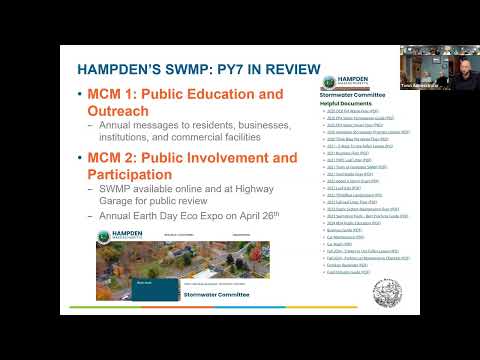
The consultants described the MS4 program’s minimum control measures — public education and outreach; public involvement and participation; illicit discharge detection and elimination (IDDE); construction site runoff control; post‑construction stormwater management; and good housekeeping for permittee‑owned operations — and noted the town already performs many of those activities (twice‑annual street sweeping, quarterly SWPPP inspections at the highway garage and transfer station, catch basin cleaning and system mapping).
Rivers recommended the town consider joining the Pioneer Valley Planning Commission’s (PVPC) Connecticut River stormwater committee for regionally coordinated outreach, saying regional committees provide targeted flyers, mailers and translation services that would help meet proposed new outreach standards. The draft 2024 MS4 permit proposes requiring municipalities to determine the top three non‑English languages in their regulated area and to provide actively engaging, two‑way outreach; consultants highlighted that 1.4% of Hampden’s population speaks Spanish per 2020 census mapping and that the draft would require Spanish translation in the town’s outreach if finalized.
On construction and post‑construction controls the consultants confirmed Hampden already has a local bylaw that addresses new impervious surface and redevelopment. For retrofit work, they recommended town‑owned demonstration SCMs such as rain gardens or detention basins tied to upcoming municipal projects (for example, drainage or paving projects) and suggested the town select up to five properties for future retrofits as the permit and guidance require.
Consultants also summarized proposed changes in the draft 2024 permit: updating the regulated area to 2020 census urbanized boundaries (which showed no change for Hampden), lowering the ammonia benchmark from 0.5 to 0.1 in the IDDE screening, and asking permittees to develop an asset management program with catch basin upgrade prioritization. The draft would ask that within five years 20% of catch basins needing upgrades receive deep sumps and hoods; consultants said that provision has raised concerns as a potential unrealistic financial burden for small towns and that they were submitting comments.
Board members and residents asked several clarifying questions about whether the town’s sampling proves sources originate in Hampden or upstream, why the state does not sample the Scantic River itself more frequently, and what pollutants are tested. Rivers clarified the MS4 program samples what the town discharges at outfalls and that the outfall testing does not alone determine whether the river’s impairment is caused by stormwater versus upstream sources; she listed the analytical parameters the consultants measure under the permit (chlorine, ammonia, surfactants, E. coli, nitrogen, temperature, salinity/conductivity and dissolved oxygen) and confirmed that only E. coli and nitrogen exceeded benchmarks in the one area.
Board member Mark (highway department staff) discussed how paving and culvert projects give opportunities to pair retrofits with roadwork; consultants encouraged the town to flag potential municipal projects in the western urbanized zone for SCM siting. Rivers also reminded the board that Hampden’s permit year 7 annual report is due Sept. 28, 2025, and that the administratively continued permit remains in effect through permit year 10 (June 30, 2028) until a new permit is finalized.
Ending: Consultants said they would keep the town updated on the draft permit timeline and on any changes to proposed requirements; they urged Hampden to continue routine maintenance activities already underway and to consider membership in the regional outreach committee to meet evolving public‑education expectations.