Get Full Government Meeting Transcripts, Videos, & Alerts Forever!
Get email alerts on the LGBTQ Pride Flag Policy topic
No spam. Unsubscribe anytime.
Lake Bluff trustees direct staff to draft display policy after public comments on Pride flag
Summary
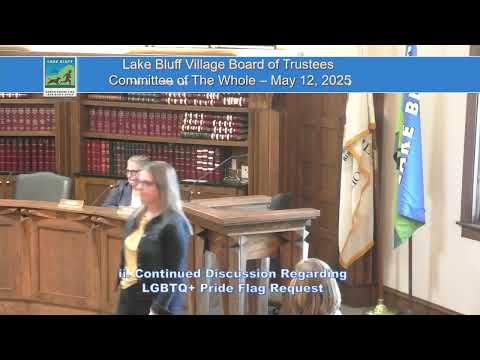
After public comments and trustee debate, the Village of Lake Bluff’s Committee of the Whole asked staff to draft a village-owned display policy that would allow recognition of multiple heritage months — including LGBTQ+ Pride — and return it to the board at a future meeting.
Lake Bluff trustees directed staff to draft a village-owned display policy to recognize multiple heritage observances, including LGBTQ+ Pride Month, after a public comment period and an extended board discussion on May 12.
The discussion centered on whether the village should fly a Pride flag on village property; speakers urged the board to act and trustees debated scope and logistics. Lisonbee Alley, superintendent of Lake Bluff District 65, said students “would certainly feel good about seeing that in the village.” Jennifer Beeler, a resident, urged trustees to preserve progress on LGBTQ issues: “I don't wanna see things regress,” she said. Sandy Hart, a member of the Lake County Board, described the county's practice of raising the flag annually, saying Lake County “is a welcoming community.”
The hearing followed staff background research on how neighboring municipalities handle symbolic displays. Drew, a village staff member, summarized examples from Highland Park, Evanston and Highwood and noted differences in practice: Highland Park maintains city‑owned small flags it places on the lawn for residents to take, while Highwood places Pride flags on alternating downtown flagpoles as part of its special‑events program. Staff also reported a practical constraint in Lake Bluff: only one municipal flagpole on the village green can support multiple flags without additional infrastructure.
Trustees who spoke divided between endorsing a simple Pride flag display and broader proposals. Trustee Fisher said flags can carry “baggage” and proposed communicating a welcoming message aimed especially at young people. Another trustee proposed commissioning rainbow‑colored decorative dogs as a nonflag, community‑centered symbol. Trustee Susan (last name not specified) said she favored a broader approach that includes multiple heritage observances rather than recognizing a single group. Several trustees suggested a set of heritage observances — including Black History Month, Women's History Month, Asian American and Pacific Islander Heritage Month, Jewish American Heritage Month, Hispanic Heritage Month, LGBTQ+ Pride Month, Native American Heritage Month and National Disability Employment Awareness Month — be eligible for village recognition.
Board members discussed how such recognition would be implemented. Staff said the intention is for the village to own any display items used on village property (the village’s speech), not to accept private displays as official village speech. Trustees and staff identified two implementation options: (1) village‑owned flags or small giveaway flags placed on the village green for residents to take, modeled on Highland Park, or (2) hoisting a single village‑owned commemorative flag on village property for a defined period. Staff noted the village currently has one flagpole on the village green capable of carrying multiple flags and that adding or modifying a pole would be a separate discussion with additional cost and time.
There was no formal vote to adopt a policy. Instead, the board coalesced around a direction: staff should draft a display/recognition policy similar to examples reviewed, naming the heritage observances the board discussed and clarifying that flags or displays would be village‑owned, subject to an application process and brought back to the Village Board for adoption. Peter (village staff) and Drew were asked to prepare the draft for a future meeting; staff said they would return with proposed language and practical recommendations.
The exchange included several public‑comment speakers and multiple trustees, and trustees explicitly distinguished discussion from direction. No policy was adopted on May 12; the board's action was to request a draft policy and implementation details for a future agenda.
Trustees and members of the public framed their remarks around student welfare, community welcome and practical mechanics. No statutory citations or new ordinances were adopted at the meeting. The committee adjourned after providing staff with direction to prepare a draft policy for board consideration at a subsequent meeting.