Get email alerts on the Middle Housing Code topic
No spam. Unsubscribe anytime.
Council reviews middle housing code amendments to implement state law and allow more unit types
Summary
City staff presented draft middle-housing code amendments intended to implement state requirements (HB 1110 and related bills). Changes would allow duplexes in R-1, expand permitted unit types citywide, authorize unit-lot subdivisions and update ADU rules; the council scheduled a public hearing on June 3 with tentative adoption on June 17.
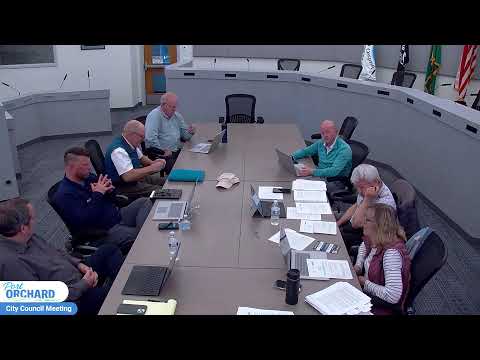
Port Orchard planning staff presented draft middle-housing code amendments and a proposed map of zoning changes required to comply with recent Washington state housing laws; council members reviewed the draft and heard a timeline for public hearing and adoption.
The amendments matter because state law requires cities to allow “middle housing” types in predominantly residential districts; the changes will alter how many units can be built on many lots, allow unit-lot subdivisions and change accessory-dwelling-unit (ADU) rules, with practical effects on housing type, ownership and development review.
Jim, a planning staff member, said the amendments respond to legislative changes including House Bill 1110 (middle housing), House Bill 1337 (ADUs) and a provision of the Revised Code of Washington on unit lot subdivisions. “HB 1110 … requires planning cities to allow middle housing in all predominantly residential districts by the June this year,” Jim said. He described the code shift from a “one building per lot” form toward unit-density limits (for example, the draft would allow two dwelling units per lot in an R-1 district, four in R-2 and six in R-3 for middle-housing building types). Apartments remain the primary use introduced in higher-density districts.
The draft also responds to HB 1337 on accessory dwelling units. Staff said the proposed ADU provisions limit each ADU to 1,000 square feet, do not require owner occupancy or street improvements, and incorporate the state requirement that ADUs may be sold as condominiums and that certain legally established accessory buildings may be converted without variances. The code would cap ADU impact fees at 50% of the principal unit fee, consistent with recent council action.
The amendments add unit-lot subdivision language so a recorded parent lot that meets zoning requirements may be divided into unit lots that can be sold fee-simple; setbacks and minimum lot sizes remain applicable to the parent lot perimeter, not the unit lots. Staff noted technical constraints such as stormwater capacity and utility layout may limit subdivision potential on some parcels.
Other major changes include consolidated, quantitative design standards (façade transparency, blank-wall treatment, porches and entry orientation) to reduce subjective review, a new approach to parking and circulation aligned with the state’s recent Senate Bill 5184 guidance (placing more responsibility on applicants to justify parking needs), and a uniform approach to height-overlay districts. Staff told council the Department of Commerce reviewed the draft; Commerce reduced its comments to two and the city issued a Determination of Non-Significance (DNS) on April 29.
Council questions covered potential effects in older neighborhoods, how existing CC&Rs interact with ADU and subdivision rights, whether unit lots must be equal size (they need not be), and infrastructure constraints. Staff said CC&Rs that predate the law are not required by the legislature to comply and remain enforceable unless changed by the homeowners’ association; however, any land-use action can be challenged by affected parties in the process.
The council did not adopt the amendments at the study session. Staff said the planning commission public hearing record remains open for some items and that the council’s tentative schedule is a planning-commission recommendation, a council public hearing June 3 and possible adoption on June 17 so the city meets the June statutory deadline for related comprehensive-plan amendments. The city will continue outreach and return the final ordinance for council consideration.
AI generated
The text on this page is AI generated. Summaries, highlights, analysis, and video transcripts are all produced from the original source material.
AI can make mistakes, so if you spot one, and we will fix it for everyone.
Note: the source content is unaltered by us. Any content source we link to, be it a video, an audio recording, or a document, is presented exactly as its publisher released it. That publisher is usually a government body, sometimes an individual official or another organisation.