Get Full Government Meeting Transcripts, Videos, & Alerts Forever!
Get email alerts on the State Revenue Forecast topic
No spam. Unsubscribe anytime.
REC raises near-term revenue outlook amid early effects of November tax overhaul
Summary
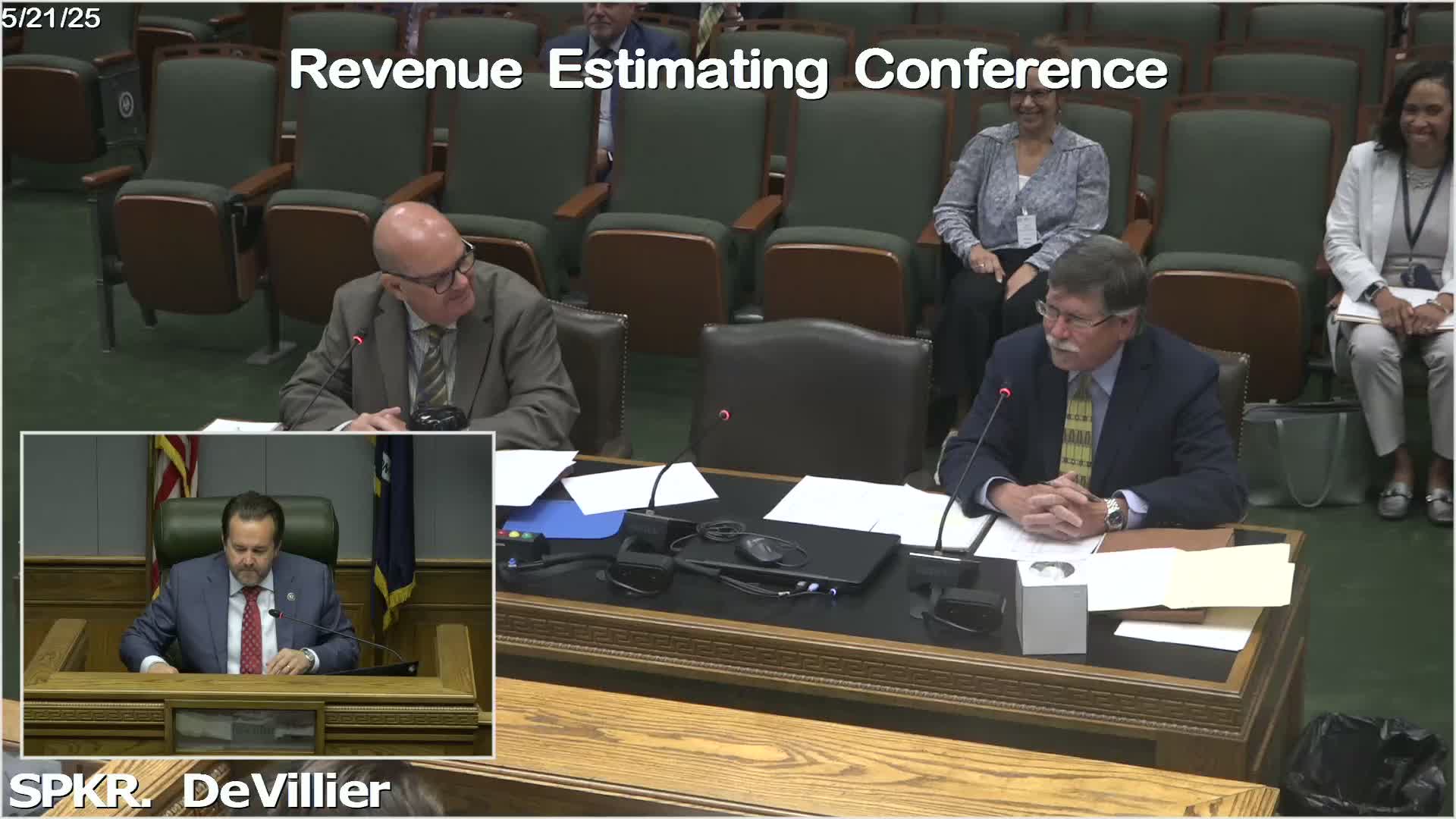
The Revenue Estimating Conference on May 21, 2025, adopted updated revenue forecasts for fiscal 2025 and 2026 after presenters said early collection data show sales-tax strength but sharp declines in severance and continued volatility in corporate collections following November's tax changes.
The Revenue Estimating Conference on May 21, 2025, adopted updated Legislative Fiscal Office revenue forecasts for fiscal 2025 and fiscal 2026 after staff presented early collection data showing mixed effects from the November special session tax changes.
Manfred Dix, a division presenter, told the panel, "it is the division's proposal to increase the State General Fund, compared to official forecast by about $136,000,000," while presenting preliminary results for fiscal 2025 and discussing program-by-program movements.
The update matters because lawmakers implemented major tax changes in the November special session that took effect Jan. 1, 2025 (with the corporate franchise tax elimination phased in Jan. 1, 2026). Those changes included a higher personal exemption and a lower, flatter individual income tax rate, an increase and base expansion for sales taxes, and a timetable to eliminate the franchise tax.
On individual taxes, Dix said the state has only a few months of collections under the new rules and that the data are not yet a long-term trend: "we had about, what, 3 months of collections for such an important tax change is probably not that much to give us a picture" of how the economy will digest the changes. He reported the division's preliminary individual income tax estimate as roughly 6% ahead of the December official forecast but about 3% below last year's collections year to date.
Presenting the same data, Greg Albrecht said sales taxes are responding fastest and corporate receipts will take longer to show structural effects. "Sales tax will respond much more quickly," Albrecht said, and added that corporate collections are "by far the most volatile tax source we have." Albrecht reported being roughly $129 million higher than the adopted FY25 forecast and about $139 million higher for FY26; Dix's division figures were about $136 million higher for FY25 and roughly $200 million higher for FY26.
Both presenters highlighted three large drivers: individual income tax, sales taxes (general and motor vehicle), and corporate taxes. Dix noted sales-tax collections were running ahead of last year (he said general sales tax was about 5% ahead year to date and motor vehicle sales tax about 14% ahead), while severance collections were significantly weaker: "my forecast for current year for the severance tax is about 320,000,000 compared to the current official forecast of, 500 plus million," a roughly $180 million reduction he attributed to lower natural gas rates, refunds and exemptions.
On corporate receipts, Albrecht warned of continued volatility and uncertainty as the state phases out the franchise tax and adjusts credits. "We capped it off at that 600,000,000 … but in terms of the gross numbers … the volatility is still there," he said. Both presenters said corporate effects are multi-year and that full patterns may take two to three years to appear, while sales-tax impacts should be visible within months.
After discussion, the REC voted to adopt the Legislative Fiscal Office forecasts as reflected in the meeting schedules for FY25 and FY26 and the long-range outlook; motions to adopt those schedules were made and carried without objection. The panel also authorized staff to make technical changes to the adopted schedules and gave staff additional time during the interim to review REC sheets.
Committee members and staff said they will continue to monitor month-to-month collections and revise forecasts as more data accumulate.