Get Full Government Meeting Transcripts, Videos, & Alerts Forever!
Get email alerts on the Municipal Budgeting topic
No spam. Unsubscribe anytime.
Finance committee previews next week’s budget vote, outlines nondiscretionary cost pressures and limited tax-relief options
Summary
Springfield City finance staff told the Finance Committee on May 20 that most of the $56 million year-over-year increase in the FY26 budget is nondiscretionary, limiting room for new tax relief; committee members discussed exemptions, school transportation costs and use of one-time reserves.
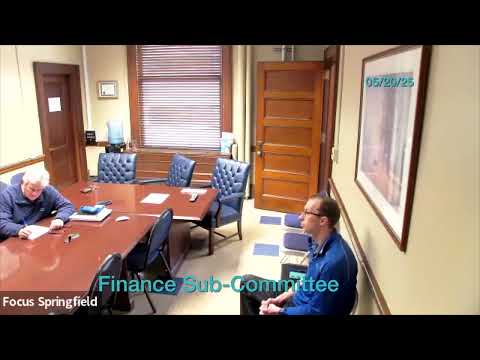
The Springfield City Finance Committee met May 20 to finalize messaging for a budget vote next week, and city finance staff said most of the year-over-year increase in the FY26 spending plan is nondiscretionary.
Kathy, a city staff member who presented the department’s figures, said, “The green. Pension is, like, 0.2. The state is 62.7%, property taxes is 29%, local receipts is 7.8.” She told the committee that the school department “basically takes all of the state aid plus a part of our property taxes.”
The committee was told the city’s operating budget increased by $56 million from FY25 to FY26, and that roughly $51 million of that increase is nondiscretionary. “So of the 56,000,000 that went up from '25 to '26, 51 million where there was nothing we could do about,” Kathy said. She listed examples of nondiscretionary increases including the school department, school transportation, pension contributions, state assessments and contract obligations.
Those nondiscretionary costs leave the remainder of the increase—about $5 million—to be absorbed by city departments. Kathy said roughly $3.2 million of that $5.4 million discretionary increase represents police raises.
Committee members pressed for clarity about tax-relief options and existing exemption programs. Patrick Greenhall, chair of the Board of Assessors, described the city’s tax-exemption programs and uptake. “Veterans, blind, 17D and 41C. Veterans can be multiple categories,” Greenhall said, and he gave program counts from fiscal-year data. He also described the state “circuit breaker” credit, saying that in 2021 approximately 1,600 people received that credit and that qualifying taxpayers can file up to three years retroactively.
Kathy noted recent local changes to exemption rules: the city lowered the age threshold for the 41C exemption from 70 to 65 and doubled the exemption amount beginning in fiscal 2024, and this year the city accepted state authorization to double veterans’ exemptions under what she referred to as the Heroes Act. She said the FY26 increase will raise some veterans’ exemptions “from 800 to 2,000.”
Committee members also discussed school transportation funding. Kathy said the transportation budget is on the city’s side of the ledger and estimated transportation costs at about $45 million to $50 million. She noted a longstanding proposal to treat Springfield as a regional district for transportation reimbursement, which would bring an approximate 25% state reimbursement for transportation costs—but that change would require state action. “That would be the state allowing that,” she said.
Members reviewed how the mayor and council have used one-time sources to limit the levy increase. Kathy said the city has used free cash and interest from T-bills to reduce the levy and that the mayor committed $1 million to a local fund created by a home-rule petition, which is pending at the state house.
Several committee members described the difficulty of finding further cuts without affecting services. One member recalled a prior year when department-line reductions produced immediate service impacts and required detailed line-by-line work to implement. Kathy said the budget team did a three-year line-item analysis and still arrived at a remaining $2 million gap that was to be offset using a pension reserve set aside in prior years.
The committee agreed that department heads should be present at the upcoming council session in case members propose cuts. Kathy said she provided a PowerPoint to committee members that separates nondiscretionary from discretionary items and “spelled it all out.” The meeting was framed as preparation for the formal budget vote the following week.
The committee did not take any formal votes during this session; members discussed options and outreach plans ahead of the vote.