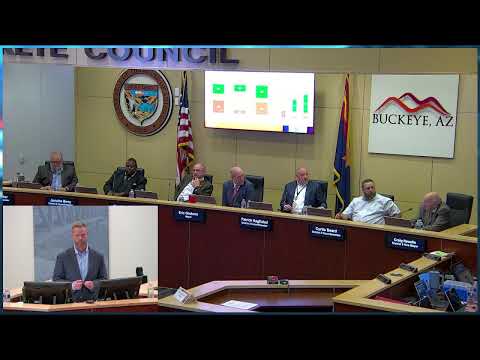
Buckeye staff present 10-year Parks and Recreation Master Plan after citywide outreach
Loading...
Summary
City staff and consultant Kimley Horn presented a draft 10-year Parks and Recreation Master Plan to the City Council, reporting extensive public outreach, a statistically valid survey, service-level gaps and a multi-decade strategy to reach council targets for park acreage and amenities.
The City of Buckeye presented a draft Parks and Recreation Master Plan to the City Council on May 20, 2025, after a multi-year outreach process that included a statistically valid survey, community events and stakeholder meetings, staff said.
Miranda Gomez, community services director, said the document is a long-range, 10-year policy plan produced by Community Services staff with consultant Kimley Horn. “We are excited to present to you the draft Parks and Recreation Master Plan,” Gomez said. Gomez and Bob Weiser, deputy director in community services, told council members the plan compiles resident input, an analysis of levels of service and recommended themes and implementation objectives.
The nut graf: Buckeye’s master plan identifies gaps between current park provision and council-adopted service goals from 2016 and lays out program and amenity priorities, land-acquisition opportunities and a 30-year, stepwise approach to increase developed park acreage. Staff said the draft is intended to guide decisions and partnerships rather than serve as a capital-funding plan.
City outreach and survey results
Bob Weiser described outreach the department led with Kimley Horn and residents. “The first thing that we did is we created an interactive project website that was www.planbuckeyeparks.com,” Weiser said, and the team used online exercises, focus groups, two rounds of public meetings, event-based outreach and a statistically valid mailed survey.
Staff said the statistically valid survey sampled 4,000 random Buckeye addresses and returned 524 responses (about a 13% response rate; the project’s goal was 10%). Combined public input reported to council included 4,305 total inputs, more than 1,000 website survey responses, roughly 250 focus-group participants, about 1,800 votes gathered at community events and social-media engagement. Weiser and Gomez framed that feedback as the basis for prioritizing facilities and programs.
Top facility and program priorities
Gomez summarized the priority investment ratings drawn from the surveys and outreach. At the citywide level, the highest-priority facility investments were aquatic and pool facilities; fitness and exercise facilities; cultural centers for visual and performing arts; outdoor-adventure activities; and indoor basketball and volleyball courts. Top program priorities included hobby and interest classes, fitness programs, events and festivals, art programs and family programming.
Gomez highlighted a contrast between facility priorities and program demand: “As those numbers start growing... I think that you'll start seeing some of those priority investment rating numbers shift, because programs and facilities are not available to our residents,” she said, noting the department recently closed its spring season with a wait list of about 120 children for youth sports programs.
Levels of service, inventory and goals
Staff presented developed-park-acre metrics and comparisons with peer cities. Weiser said the city’s developed park acreage per 1,000 residents (city-owned developed parks open to the public) is currently about 1.09 acres per 1,000; including HOA-provided parks raises Buckeye’s total developed parks to about 5.3 acres per 1,000. The 2016 City Council standard remains an 8‑acre-per‑1,000 goal (split in 2016 as 4 city acres + 4 HOA acres per 1,000). The draft plan does not propose changing the 8-acre target.
Weiser described city-owned undeveloped parcels and partnership opportunities that would increase the developed-park inventory if advanced: about 100 acres the city purchased near Terra Valis, 40 acres along the Gila River, and parts of a Joe Foss Sports Complex lease (staff said about 50 acres of the 250-acre lease could be counted as developed). He also identified other opportunities including state trust land parcels north of I‑10, Bureau of Land Management parcels north of the CAP canal, and flood-retention areas that might be adapted for sports fields in coordination with the Flood Control District of Maricopa County.
To move toward the adopted 4 city acres per 1,000 target, the plan proposes a stair‑stepped approach across multiple decades. Staff presented a 30‑year phasing that would require tens to hundreds of additional developed acres at staged intervals (examples given by staff: roughly 63 additional developed acres to reach about 1.6 acres per 1,000 in the near term; roughly 209 additional acres to reach a higher interim target in the 2030s; and further acreage needed to approach long-term targets). Gomez described the schedule as achievable through partnerships with developers, school districts and land agencies rather than a city-only land‑purchase effort.
Themes, recommendations and near-term items
Gomez said the draft plan organizes recommendations under five themes: celebrate natural resources; enhance community connectivity; grow a well-distributed park system; strategically provide programming; and reinvest in existing assets. Visionary project examples included a nature center partnership, trail connections between Skyline and the White Tank Mountains Regional Parks, a 10‑year arts and culture master plan, shared-use performing arts space, and adding pickleball courts and a park-ranger program at Sundance Park.
Gomez noted the plan is not a capital-funding package, but staff asked whether voters would support dedicated funding. She said about 77% of survey respondents were “somewhat supportive” or “very supportive” of a bond, dedicated sales tax or similar funding approach, while about 5% said they were not supportive. Gomez also said the park-ranger program and other items were included in the tentative budget the department was submitting.
Next steps and approvals
Gomez told council the Community Services Advisory Board reviewed the draft on May 7 and gave a unanimous recommendation to approve. Staff listed near-term outreach and approval steps: a developer meeting planned for May 21, Planning and Zoning review on June 10 (possible recommendation), and a City Council hearing on June 17 for possible plan adoption.
Why this matters
The plan sets a policy framework that will steer facility and program priorities, partnership negotiations and how the city counts private/HOA amenities in citywide service metrics. Council members emphasized preserving open space and exploring shared‑use agreements with school districts and developers to expand recreational access without the city assuming all capital costs.
What was not decided
Council did not take a final vote or adopt capital funding as part of the workshop. The draft plan does not itself appropriate funds. Formal adoption and any bonding or tax measures would follow the outreach and public hearings outlined by staff.
Ending
Staff requested feedback and signaled readiness to return after developer and Planning and Zoning input. Gomez closed by thanking the board, staff and residents for participation and reiterated the plan’s intent: “The plan itself reflects and is inclusive of the community. It balances stakeholder and resident input. It sets a roadmap for the future.”