Get Full Government Meeting Transcripts, Videos, & Alerts Forever!
Get email alerts on the Education Finance topic
No spam. Unsubscribe anytime.
Board approves five‑year forecast, precaution plan and a levy resolution after finance presentation
Summary
The Garfield Heights City Schools Board of Education approved the district’s May statutory five‑year forecast and a precaution workbook on May 19 and passed related financial resolutions, after finance staff detailed projected deficits, the impact of county reappraisals and state funding uncertainty.
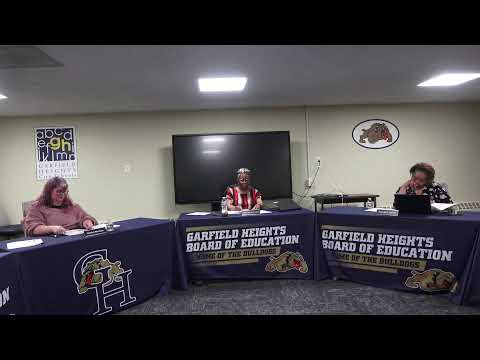
The Garfield Heights City Schools Board of Education on May 19 approved the district’s May five‑year forecast and a precaution workbook and narrative submitted to the Ohio Department of Education and Workforce, after a broad presentation on revenues, expenditures and levy strategy.
District finance staff presented a May statutory forecast that showed projected general‑fund revenue of about $47.3 million and expenditures of about $50.4 million for fiscal 2025, producing an anticipated deficit for the year. Finance staff described the result as a snapshot of current assumptions and variables, and stressed it could change as state budget language or reassessments evolve. "This forecast that we do today will be completely different tomorrow and the day after," the presenter said.
Why it matters: The forecast frames the district’s near‑term choices about staffing, transfers and ballot timing. Finance staff warned that state funding policy and county property reappraisals will drive the district’s revenue mix toward a larger local share, increasing pressure on homeowners and the district’s emergency levies.
What the board voted on: The board approved the five‑year forecast (motion moved by Miss Cox, second by Missus Daniels), accepted the precaution plan required after the Ohio Department of Education and Workforce notification (moved by Miss Thomas, second by Miss Morrison), and passed several financial resolutions including a transfer resolution and establishment of a $0.035 severance fund (both approved on roll call). Each item passed on roll call with each present board member voting yes.
Finance presentation highlights: District staff said 56% of general‑fund revenue comes from the state and 41% from local taxes in the current snapshot, and that residential property dominates the local tax base (about 79% residential). Staff warned that the county reappraisal cycle will lower effective mills and that the district has no continuing operating levies above the 20‑mill floor; the district runs emergency levies that must be renewed periodically.
The presenter said the district could avoid "hitting the guarantee" — a scenario in which state funding becomes a fixed guarantee tied to fiscal 2020 levels — but cautioned that state proposals (House Bill 96 language discussed at the hearing) could reduce targeted assistance and change how fair‑funding phase‑in applies. Staff urged the community to consider levy renewal as the primary way to offset the expected local revenue shortfall.
Board members asked about longer‑term options and the cost of placing measures on the ballot; staff answered that non‑presidential primaries are the most expensive and provided rough cost ranges for an election. The board also approved a resolution supporting full implementation of the state Fair School Funding Plan.
Ending: With the forecast and precaution plan approved, district leaders said they would continue public outreach about levy effects and the specific cuts that could be required if a renewal fails. Administrators said they will continue monthly community briefings and release a detailed list of proposed reductions and the items already cut to produce the current forecast.