Get Full Government Meeting Transcripts, Videos, & Alerts Forever!
Get email alerts on the Homelessness Parks Ordinance topic
No spam. Unsubscribe anytime.
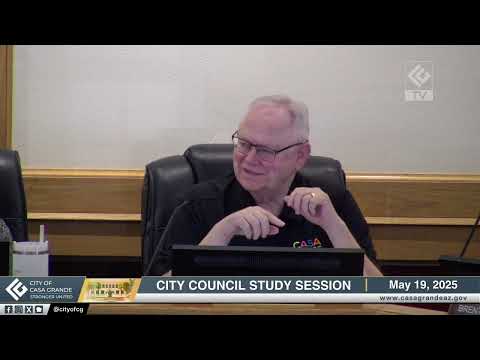
Casa Grande staff present draft ordinance to limit camping in public spaces, set park ramada time limits
Summary
City staff presented a draft ordinance at a study session that would restrict camping in public places, allow removal of abandoned property from parks, set a two-hour limit for unreserved ramada use, and prescribe notice and limited penalties; staff said outreach and services would precede enforcement.
City staff presented a draft ordinance at a study session proposing new limits on camping and abandoned property in public places across Casa Grande and asked the council for feedback on outreach and implementation.
The proposal would make camping in fountains, splash pads and lakes subject to a new prohibition, authorize the director of community services and the city manager to issue permits for camps connected to youth organizations or special events, and allow the city to remove abandoned items from parks after notice. Steven, a staff member, told the council that "There is a 24 hour notice. And if removed, the city will store the belongings for 10 days before disposing of them." He added, "This really is the last step that we plan to use. We want to use other things."
Why it matters: Council members and staff said parks use and safety motivated the draft. Staff framed the ordinance as one tool among outreach, nonprofit coordination and services rather than immediate citation. The city plans a public information campaign and a possible delayed effective date so residents and service providers can prepare before enforcement begins.
Key details discussed
- Permits and exceptions: The draft says the director of community services may issue permits to camps for youth organizations and schools, and the city manager may issue temporary permits tied to special events. Staff said permitted uses (for example, organized camps at North Mountain Park or Rodeo Grounds) would be exempt from the new restrictions.
- Ramada time limits: The park regulation draft would allow unreserved ramadas or picnic shelters to be used without a permit for up to two consecutive hours; staff defined "consecutive" as use within the same six-hour period. If a ramada is reserved, the reservation overrides the two-hour cap.
- Notice, storage and penalty: Staff described a two-step notice requirement for abandoned property and camping: mailed notice and a physical posting on the premises. If belongings are removed, the city will store them for 10 days before disposal. Brett, a staff member, said the cited penalty would be a class 3 misdemeanor and noted "the maximum fine is $500." Staff emphasized the penalty is intended as a last resort.
- Private property: Mary Fitzgibbon noted the draft also addresses camping on private property without owner permission; staff clarified that the ordinance would not prohibit ordinary backyard family camping and that officers could still pursue trespass in other circumstances. Staff said property owners would not be required to post "no trespassing" signs specifically for the camping provision.
- Implementation and outreach: Staff said the ordinance would take two council readings plus a 30-day cure period if approved; they estimated an effective date in July or August depending on revisions. Beginning July 1 under the next budget, one existing employee would be dedicated to code enforcement work focused on issues involving people who are unhoused or unsheltered. Staff described plans to coordinate with nonprofits, distribute resources and survey stakeholder organizations, publish the ordinance in the newspaper, consider signage in parks, and possibly use a warning period before active enforcement.
Discussion and stakeholder input
Stakeholders and nonprofit representatives met with staff before the study session; staff said attendees were generally supportive of the ordinance as part of a broader strategy of outreach and services. Jerry, a representative from Saint Vincent de Paul, was cited as a stakeholder who was unable to attend but works with the unhoused and vulnerable population. Council members and staff repeatedly stressed that enforcement would be intended to encourage connection to services rather than to punish without offering help.
Where the process goes next
Staff said a final ordinance will be drafted after the study-session comments and brought to the council for the first or second meeting in June for formal readings. No formal vote took place at the study session; staff sought direction on outreach and final drafting.
Ending
Council members asked staff to include robust public notification plans (including printed publication and nonprofit outreach), consider signage in parks, and build a warning period before citations if the ordinance is adopted. Staff will prepare a final draft ordinance for a future council meeting and continue coordination with local nonprofits and the police department.