Citizen Portal
Sign In

Vision Zero updates: Phoenix staff report on safety projects, grant plans and a public crash dashboard

3424026 · May 21, 2025

Loading...

AI-Generated Content: All content on this page was generated by AI to highlight key points from the meeting. For complete details and context, we recommend watching the full video. so we can fix them.

Summary

City staff and the Vision Zero Community Advisory Committee reviewed progress on the Road Safety Action Plan, recent intersection rebuilds, a yard-sign pilot, a speed-limit survey, and development of a public crash dashboard.

City of Phoenix staff updated the Vision Zero Community Advisory Committee on road-safety projects, public engagement tools and an in-progress public dashboard intended to show crash data and safety metrics.

Street Transportation Director Brandy Kelso summarized several recent accomplishments and ongoing efforts: two intersection rebuilds completed earlier this year with audible pedestrian pushbuttons, ADA ramps, flashing yellow left-turn signals and vehicle detection; a yard-sign pilot offering signs in English and Spanish; a public speed-limit survey open through May 31; and work on a large Safe Streets and Roads for All grant application (staff estimating an application up to $25 million). Kelso told the committee, “We have advertised for our school safety position. I know we've been talking about that for a while. We expect the interviews in the next 2 weeks.”

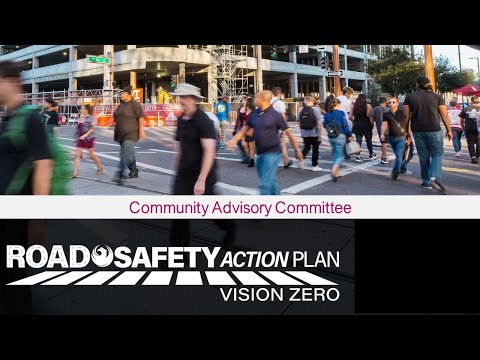
The committee’s staff presenter, Carl, reviewed the Road Safety Action Plan (Vision Zero) and the committee’s role in implementation. He said the plan, adopted by council in 2022, uses a High Injury Network (HIN) to focus limited resources where killed-or-serious-injury (KSI) collisions concentrate. Carl summarized the plan’s “five P” approach — evaluation, engineering, enforcement, education and equity — and said the initial plan’s KSI data covered 2016–2020 and identified roughly 5,400 KSI collisions in that period.

Reid presented research on public crash dashboards used by peer cities (example screenshots included Austin, El Paso and Tempe) and demonstrated an internal Power BI tool the city uses to query crash data by corridor, intersection and time of day. He asked the committee for feedback and assigned a short homework task asking members to review peers’ dashboards and send priorities for the city’s public-facing version. Committee members asked staff for an expected timeline; Reid and staff said the city’s IT and public-information processes mean building a public dashboard could take many months.

Public commenters and committee members asked that any public dashboard be accessible, educational and show how Vision Zero funding is spent. Amanda asked that the dashboard include an ability to see how engineered changes line up with outcomes, and Nicole Rodriguez urged transparency on funding allocations and a quicker rollout: “Power BI works very well on websites. It’s very plug and play once you get it going,” she said. Chair Ed asked staff to send committee members links and to collect feedback via email through committee staff.

Additional items in the director update included 1,200+ signalized intersections citywide, two safety-specific intersection projects completed in March and April, and the city’s yard-sign pilot (three signs across five stations). Kelso also reminded the committee about Bike to Work Day and about the city selecting Aztec Engineering to consult on an Indian School corridor project; council approval of that consulting contract will be sought in June.

Staff said the committee’s next formal deliverable will be the second annual Vision Zero update; staff are preparing the 2024 annual report and expect to bring more detailed data to a future meeting.

Committee members and public speakers urged greater transparency on project selection, requested metrics such as crash modification factors and benefit-cost ratios for proposed projects, and asked staff to coordinate Vision Zero work with other departments, notably planning, fire and police. Several members asked that emergency-response preemption and traffic-signal priority be considered in project design and that data on preemption-equipped vehicles and signals be shared with the committee.

The city posted links for materials and public tools at phoenix.gov/roadsafety; staff asked the committee to provide written feedback on dashboard priorities through the committee coordinator.