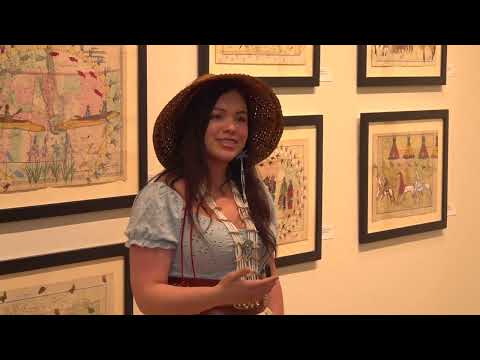
Aspen Decker links Salish ledger art to language revival and traditional fire, hunt knowledge
Loading...
Summary
Artist and linguist Aspen Decker told an audience at Radius Gallery in Missoula that she uses ledger art to preserve Salish language, seasonal-round knowledge and traditional fire-management practices, and described how those practices guided communal buffalo and elk hunts.
Aspen Decker, a linguist, historian and ledger artist, told a Radius Gallery audience in Missoula that she uses ledger art to teach and preserve Salish language, seasonal-round knowledge and traditional fire-management techniques.
Decker said the visual work embeds stories passed down “from countless generations over thousands of years” and that combining artwork and language helps keep those stories—and the community’s seasonal knowledge—alive. “Fire is a tool that we use for land management,” Decker said, describing controlled burns she said were used to renew grassland and manage travel routes.
Why it matters: Decker framed ledger art as a vehicle for cultural perpetuation and language revitalization. She described how seasonal markers—plants and animal behaviors—dictated travel and harvest cycles, and how those patterns were encoded in both language and art. She also connected the art to specific practices, including communal hunts and traditional regalia, saying the visual cues in ledger art communicate identity and role within the community.
Decker described “fire knowledge,” which she said was deliberate and managed by people who knew when and where to burn to support biodiversity and travel routes. She said those burns could concentrate animals on peninsulas or other terrain features to enable communal hunts; she told the audience such hunts could yield “up to around 20 elk, 20 deer in one hunt,” a scale she said supported large numbers of people in the community.
She also explained how language encodes detailed spatial and demonstrative distinctions. Decker discussed Salish demonstratives—words for “here” or “there” that vary depending on what a speaker has already established in conversation—and described her academic work on the language’s structure. She said an orthography for Salish was developed in the 1980s and has helped teachers and learners, while adding that pronunciation and fluent usage still require learning from speakers. “Unless you’re a speaker or have learned from a speaker, you won’t really understand the correct way to pronounce it and the flow,” she said.
Decker described ledger art conventions—how clothing, regalia and painted objects identify people in narrative images even when faces are not rendered—and cited archival ledgers as a continuing influence. She pointed attendees to online resources including ledgerart.org and said some historical collections contain “around 1,800 ledgers.”
On cultural continuity she said elders’ stories remain present in art and language. She described teaching her children Salish and said, “I only talk Salish to my kids,” linking her artistic practice with everyday language transmission.
Decker concluded by outlining that her talk was the first in a three-part series; she said the next talks will address early contact with Euro-American explorers and traders and, in a later session, the reservation era and policies such as the Dawes Act that altered seasonal travel and settlement patterns.
The presentation included audience questions about horses, color choices in regalia, the chronology of oral stories and technical aspects of rendering language in writing. Decker drew on apprenticeship with elders and formal linguistic study to answer the questions, describing both the lived practice of language immersion and the technical phonetic symbols used to represent Salish sounds.