Get Full Government Meeting Transcripts, Videos, & Alerts Forever!
Get email alerts on the Energy Efficiency Affordable Housing topic
No spam. Unsubscribe anytime.
Missoula panel: local groups push energy upgrades for affordable housing as aid and contractors tighten
Summary
Panelists from Climate Smart Missoula, Human Resource Council District 11 and Habitat for Humanity of Missoula described local energy-efficiency successes, contractor and funding shortfalls, and policy priorities including community solar and weatherization readiness funding.
At a panel in Missoula, panelists from Climate Smart Missoula, Human Resource Council District 11 and Habitat for Humanity of Missoula urged faster, better-funded energy-efficiency work for low-income homes while warning that federal and local support is unstable.
The issue is urgent, panel moderator Derek Goldman said: “a household’s energy burden can have detrimental impacts on affordability and the overall quality of life.” Goldman cited the Department of Housing and Urban Development definition that an affordable energy burden is no more than 6% of household income and noted that “here in Montana, 27 percent of households, nearly a 20,000 of them have higher than 6% energy costs compared to 20% nationally.”
Panelists said the community has local successes but faces funding cuts, contractor shortages and program complexity that limit scale. Amy Sillenberg, executive director of Climate Smart Missoula, highlighted a range of local efforts — municipal rebates for heat-pump water heaters, a county-run home upgrade hub for outreach and a Climate Smart carbon-offset fund that helped pay for heat pumps in low-income veteran housing. “We started a carbon offset footprint fund at Climate Smart, where we could fill the gap,” Sillenberg said.
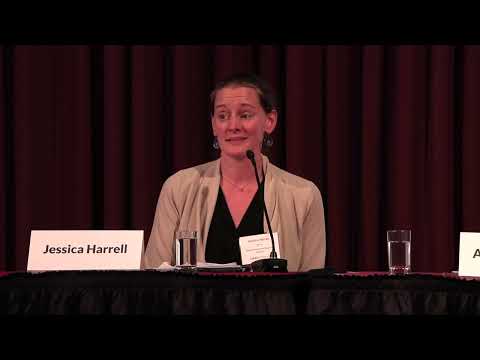
Jessica Harrell, residential energy services manager at Human Resource Council District 11, described on-the-ground weatherization work and health-and-safety repairs done alongside efficiency upgrades. Harrell said Montana’s Low Income Home Energy Assistance Program and weatherization services remain in use but are constrained: “We as a state of Montana serve around 16,000 households through the Low Income Home Energy Assistance Program... In our Tri County area, we've been serving over 3,000 households,” she said, adding that many eligible households do not apply because of transportation, awareness or paperwork barriers.
Jason Guzmer, regenerative design project coordinator at Habitat for Humanity of Missoula, described construction choices that reduce operating costs without raising home prices, including double-stud walls, dense-pack cellulose and hydronic heating designs. Guzmer offered reported cost comparisons from local pilot work (as presented at the panel): a typical high-performance exterior-foam assembly at about $1.68 per square foot versus a double-stud 2x4 wall at $0.42 per square foot, and refrigerant copper lines quoted at roughly $10 per foot versus insulated PEX at about $0.10 per foot for some hydronic systems.
Panelists identified the main barriers as (1) unstable federal and private funding streams, (2) program rules that limit flexible solutions for low-income households, (3) a shortage of trained contractors for heat pumps and other high-performance work, and (4) limited capacity to deliver community-scale renewables. Harrell described regulatory limits tied to funding that sometimes require prior approval for fuel switching, and she said her agency must ask funders before installing a heat pump. “The worst thing they could tell me is no,” Harrell said; in one case they received approval and “we were approved to be able to do a fuel switch on this home and electrify this home for this individual.”
Panelists also flagged recent and prospective policy moves. Gold-standard community solar legislation awaiting the governor’s signature would require the Public Service Commission to design the program and include provisions aimed at preventing participation by households that already have solar, a feature intended to prioritize renters and others without rooftop access. The panel urged preserving major federal tools, including the Inflation Reduction Act programs, and pointed to state and local policy levers such as Missoula County’s updated development guidance (chapter 9) that offers design and setback flexibilities to enable denser, more efficient housing.
On practical steps, the panel recommended better outreach and education (home energy reports and home tours were cited as effective), coordinated rebate and contractor programs, workforce training for tradespeople, and greater use of “weatherization readiness” funds that pay for necessary repairs (roofs, mold abatement, vermiculite removal) so homes can receive insulation and other upgrades. Jessica Harrell described the readiness approach as a way to move homes from “outside our scope” to eligible for conservation measures.
Panelists emphasized that many efficiency measures are “low hanging fruit”: attic insulation, air sealing, window and door caulking, smaller/more efficient building footprints, and landscaping for summer shading. They also stressed that some higher‑upfront-cost choices—continuous insulation, electric systems and integrated solar—reduce lifetime costs and tenant energy burden, but require upfront funding and investor or donor buy-in.
The panel closed with calls to protect existing federal programs, streamline utility rebate access for low-income customers, expand contractor training and coordinate community solar design so it benefits renters and low‑income subscribers. No formal actions or votes were taken at the panel; the session was a policy and practice discussion intended to inform local practitioners and policymakers.