Get Full Government Meeting Transcripts, Videos, & Alerts Forever!
Get email alerts on the Flood Control topic
No spam. Unsubscribe anytime.
Cochise County supervisors discuss cutting flood-district tax, refocusing projects toward rural recharge and road drainage
Summary
Supervisors discussed whether contingency funds in the Flood Control District could allow a lower tax rate and debated shifting spending from urban recharge projects to rural recharge, gabion-style retention and road drainage; staff will return with a June work session and mapping.
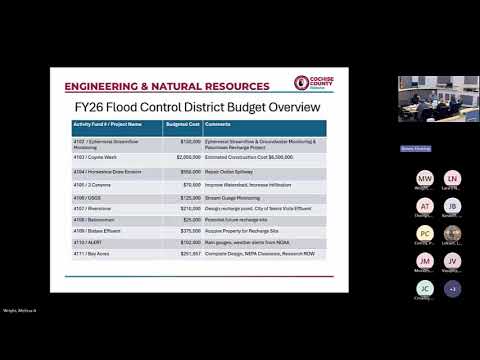
Cochise County supervisors on an agenda item about the Flood Control District reviewed a list of planned projects and asked staff to return in June with a work session and mapping that show where roads and recharges flood during monsoons.
The discussion centered on whether contingency balances could let the district reduce the tax rate "down to 1¢" or near zero while still funding planned construction and design work, and on shifting spending from urban recharge efforts toward rural recharge and road drainage improvements.
Why it matters: supervisors said choices now will determine whether money is spent on engineering and monitoring or on on-the-ground measures such as gabion rock walls and retention features that some supervisors and ranchers favor to slow runoff and increase groundwater recharge. Several supervisors warned that some studies and design work are costly and asked staff to show where money goes before any permanent rate change.
Most important facts: Joe, deputy county administrator, presented a list of flood-control projects and said there had been "lots of conversation" about how the board wants to move forward on the floodplain and whether contingency funds could be used to lower the tax. Joe said the list shows which projects would use district funds if reserves were spent down.
One supervisor questioned the $210,100 line item described for designing a Sierra Vista-area recharge pond and asked, "what does that entail?" Another supervisor urged moving more recharge work to the county's drier west side and using lower-cost retention measures — gabion rock walls and slowed flows — instead of concrete-lined washes.
Several supervisors stressed that some projects are tied to existing contracts or grants and cannot be immediately stopped; staff noted there are wage and operations lines in the budget and a roughly $1 million contingency earmarked for potential road upgrades tied to flood impacts. A speaker noted a $3,000,000 total shown on one budget line, and another speaker flagged an apparent $251,000 item for Nevada-related costs as unclear.
The board directed staff to prepare a more detailed review and a June work session on flood-control projects, including mapping that shows recurring road flooding locations and the specific purposes of large design and contingency line items. Joe said staff is "getting some mapping done" to show consistent flood spots during monsoons and will present that data.
Discussion vs. decision: the item produced discussion and a scheduling direction to staff; there was no motion or formal vote recorded on the flood-control tax rate or on changing project scopes.
Local context and constraints: participants referenced Sierra Vista, the City of Sierra Vista effluent routing north of the sewer plant’s outfall, the San Pedro Basin, Wilcox Basin, Douglas Basin, Hereford and Benson as areas affected by recharge and flood control choices. Speakers also discussed Fort Huachuca and litigation and regulatory history as background for past flood-control priorities.
Next steps: staff will return to the board in June with a work session focused on projects and with mapping and project-level explanations to inform any future decisions about tax rate or project prioritization.