Citizen Portal

Gallego credits bioscience, chip investments and new Asia flights for Phoenix economic gains

3424022 · May 21, 2025

Get AI-powered insights, summaries, and transcripts

Subscribe
AI-Generated Content: All content on this page was generated by AI to highlight key points from the meeting. For complete details and context, we recommend watching the full video. so we can fix them.

Summary

Mayor Kate Gallego highlighted major private and public investments — from bioscience campus growth and a $165 billion expansion by TSMC to a new Starlux nonstop to Taipei — and tied them to workforce training and corporate relocations during the State of the City address.

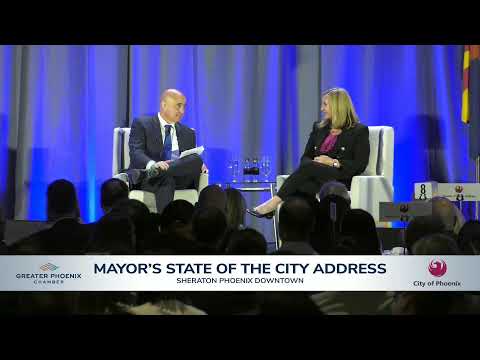
Phoenix Mayor Kate Gallego told a standing-room audience that “the state of our city is strong and growing stronger every day,” and outlined a string of private and public investments she said are reshaping the city’s economy.

Gallego said Phoenix’s bioscience sector has attracted nearly $7,000,000,000 in capital investment and more than 8,000,000 square feet of primary facilities since she took office. “Having multiple medical schools in Downtown Phoenix is a game changer for our entire region,” she said, describing ASU Health’s new medical school and other local academic investments.

The mayor also highlighted semiconductor investments, saying Taiwan Semiconductor Manufacturing Company (TSMC) expanded from an initial roughly $12,000,000,000 commitment in 2020 to about $165,000,000,000 in total investment. Gallego described apprenticeships tied to that growth and said they are providing pathways to higher-paying jobs: Jennifer Dela Cruz and Nolan Cottingham were named as local apprenticeship success stories who moved from service jobs into semiconductor technician roles.

Gallego tied the semiconductor ecosystem to broader economic advantages, including cargo and air service. She announced that, pending final airport approvals, Taiwan’s Starlux Airlines intends to launch nonstop service between Phoenix Sky Harbor and Taipei starting next February, operating three times weekly on a wide‑body aircraft. The mayor said that direct air service will reduce logistics steps for time‑sensitive semiconductor parts and broaden travel options for Asia‑based employees and executives.

The mayor framed these private investments as drivers for local workforce and infrastructure programs. She said the city is sponsoring an apprenticeship program tied to TSMC and promoted a talent initiative called Innovation '27, a public‑private partnership with ASU, NAU and Maricopa Community Colleges to fast‑track credentials and degrees for in‑demand technical work.

Gallego also listed corporate relocations and headquarters growth, citing United Foods International’s headquarters move, Fender’s planned consolidation into a local headquarters, and other companies expanding operations in the Loop 101 corridor.

Todd Sanders, president and CEO of the Greater Phoenix Chamber, opened the event and introduced the mayor. Steve Cisneros, vice president of airport operations for Southwest Airlines, provided separate remarks earlier in the program about Southwest’s local operations.

Taken together, Gallego said, these industry and education developments are “building the biosciences” and “creating the ripple effect” that will yield new jobs and business activity across Phoenix.

Gallego’s remarks did not announce new city legislation tied to the investments; she described current and planned city programs to align training and infrastructure with private growth.