Get Full Government Meeting Transcripts, Videos, & Alerts Forever!
Get email alerts on the Public Health topic
No spam. Unsubscribe anytime.
Lewiston planning staff present draft ordinance to license and limit syringe service programs; council asks for expert input
Summary
City planning staff presented a draft ordinance to license state-certified syringe service program (SSP) providers, require fixed sites, impose 1-to-1 exchange limits, set buffer zones and limit providers to two; councilors asked for subject-matter expert testimony and raised concerns about zoning impacts, client privacy and program hours.
John Connor, Lewiston's director of Planning and Code Enforcement, presented draft ordinance language for licensing and regulating syringe service programs (SSPs), describing a local framework the city could use to oversee state-certified providers.
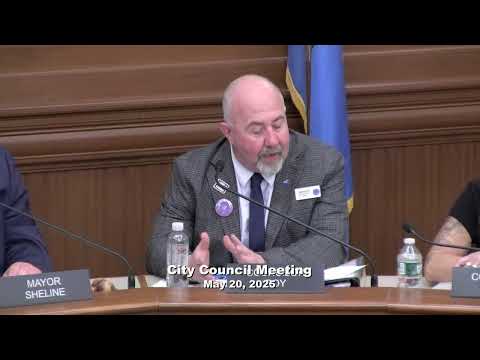
Connor said the draft aims to address needle litter and public health by imposing city-level licensing and operational standards in addition to state certification. He told the council that, since 2020, "according to the Maine CDC's own annual reports, Maine SSPs ... have a statewide delta ... of nearly 1,500,000 needles," and that Lewiston alone reported a delta of roughly 125,000 needles in 2023.
Key elements in the draft ordinance presented by Connor include dual authorization (state certification plus a city license), a limit of two authorized providers in the city, operation primarily from a single fixed location, buffer zones that would keep facilities at least 1,000 feet from schools, day cares, public parks, playgrounds and libraries (and 200 feet from residential properties), a required one-for-one syringe exchange per visit, annual reporting of non-identifying aggregated service metrics to the council, a city annual permit fee and inspection and enforcement authority for the city. The draft also would expressly prohibit mobile exchanges and supervised consumption/safe-injection sites.
Council discussion focused on several policy and practical issues. Councilors asked whether the combination of zoning districts plus buffer distances would leave any feasible sites within the city (one councilor warned the buffers could erase most allowed zones). Several councilors urged staff to solicit and weigh evidence from subject-matter experts and from providers; the mayor and staff said the council expects testimony from program operators and the Maine CDC at an upcoming workshop. Councillor Chittum asked that the public health committee also provide recommendations; Planning staff agreed to compile council comments and circulate a consolidated set of proposed changes for further workshops and for public hearings.
Other recurring questions included whether limiting providers to two would meet service needs, how the one-for-one exchange requirement interacts with state rules or practices (several councilors said they had seen providers distribute large quantities at once in other towns), how the city would preserve client privacy while meeting reporting requirements, whether permit fees were appropriate for nonprofit providers, and whether operational hours should be regulated to ensure consistent access. Connor said the draft had been modeled on ordinances in Manchester, N.H., Norwalk, Conn., and Sanford, Maine, and that the city attorney would review the draft.
Ending: The council did not adopt the ordinance; staff will compile council comments and pursue subject-matter expert testimony and Maine CDC input at a follow-up workshop before returning the draft for formal readings and a public hearing.