
Select Committee on Pension Policy reviews 2025 pension legislation, schedules deeper study of complex funding changes
Get AI-powered insights, summaries, and transcripts
Subscribe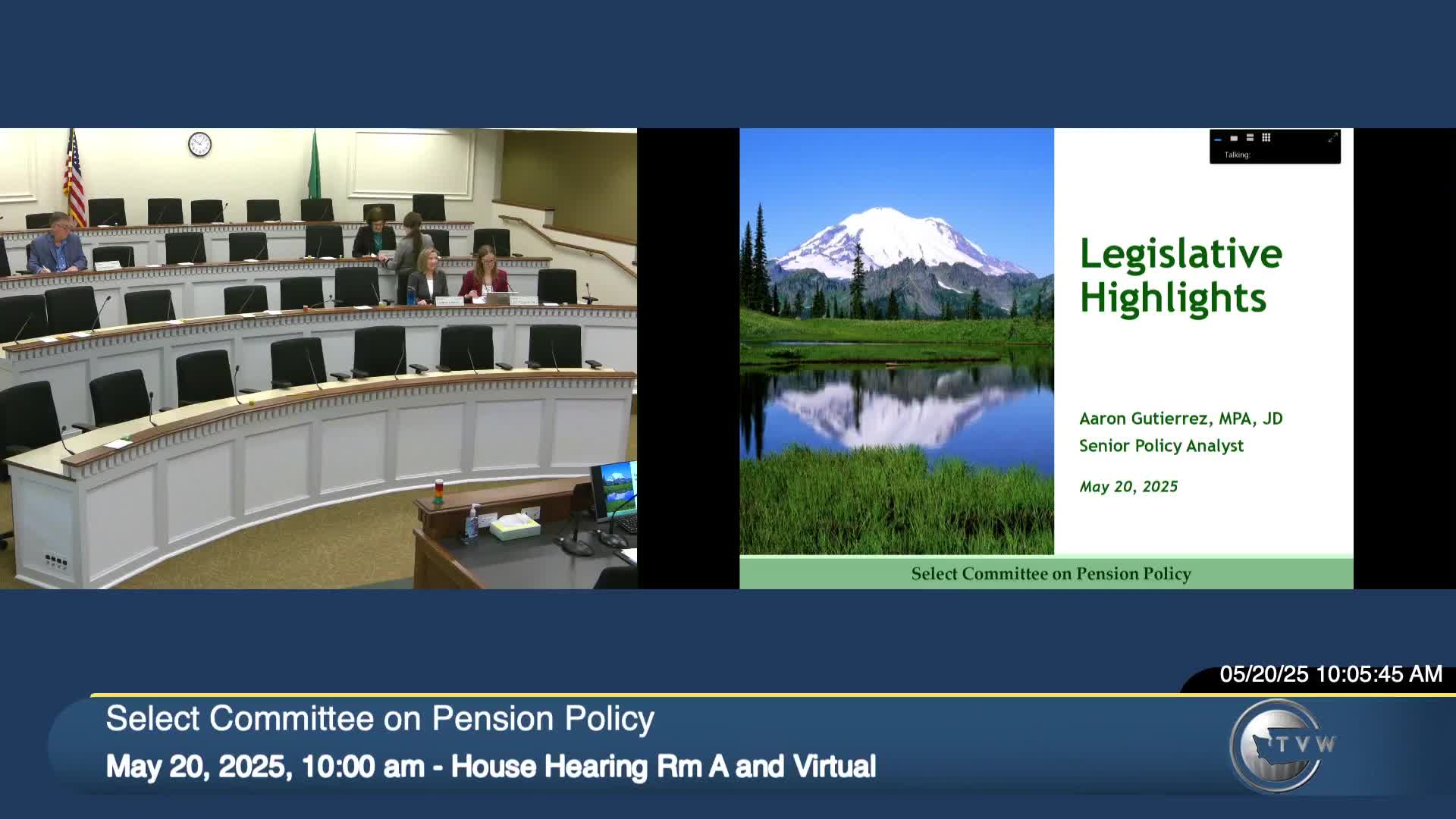
Summary
Committee staff briefed members on bills that passed and failed during the 2025 legislative session, highlighted a statutory study mandate related to a possible LEOFF 1 merger, and recommended follow-up briefings on a complex actuarial funding bill that resets unfunded liabilities and changes the assumed rate of return.
The Select Committee on Pension Policy received a high-level briefing on 2025 pension-related legislation and interim work-plan items, and members agreed to pursue deeper analysis of a complex funding bill and other statutory studies.
Melinda Zloxon, staff to the committee, summarized bills that originated from the committee’s interim work and other legislation of interest to the committee, noting which measures passed, which did not, and where statutory study mandates exist. She told members two SCPP-requested bills—one to provide a permanent plan 1 cost-of-living adjustment (House Bill 1292 / companion Senate bill 5113) and one to pay a retiree a full month of pension in the month of death (House Bill 1312 / companion Senate bill 5114)—did not pass the legislature this year. “My remarks will be high level, but there are more details in the handout,” Zloxon said.
The committee was told that an engrossed substitute bill (described in the briefing as Engrossed Substitute Senate Bill 5167) had a budget proviso directing the Select Committee to study “the tax, legal, actuarial, pension policy and administrative implications” of two specified bills affecting Law Enforcement Officers’ and Fire Fighters’ Plan 1 (LEOFF 1) and related termination/restatement proposals; the statute allows the committee to request assistance from the Department of Retirement Systems (DRS), the Attorney General’s Office, the state treasurer, the Washington State Investment Board (WSIB) and the Office of the State Actuary (OSA). The briefing noted a report on that study is due to the legislature by Jan. 9 of next year.
Committee members spent the most time on a separate funding bill (briefed as Engrossed Substitute Senate Bill 5357) that, according to staff, temporarily sets unfunded actuarial accrued liability contribution rates to zero through fiscal year 2029, then resets and re-amortizes those amounts over a 15-year period beginning in fiscal year 2030. The bill also includes a provision increasing the statutory long-term assumed rate of return from 7.0% to 7.25% and prescribes related normal-cost contribution rates; staff described it as a complex bill with “big changes” and recommended a separate, in-depth briefing. Michael Harbor, actuary with the Office of the State Actuary, said the statutory assumption has been lowered over time (from 8% many years ago), and that the state actuary had previously used figures near 7.4% before the statutory assumption was set to 7.0 percent and then increased to 7.25 percent in the session’s bill.
Sen. Conway, who identified the 5357 bill as his, said he supported the bill in part for budget reasons but asked that the Select Committee hold a detailed briefing on the long-term funding implications. “I think it would be important to have that because I'm not sure when we suspend contributions to UAL for four years what that will mean in the long run to our pension system,” he said.
Staff also summarized other statutory and administrative changes that the committee will track in the interim: a change shifting appointment and removal authority for the State Actuary from the State Actuary Appointment Committee to the Pension Funding Council (requiring four affirmative PFC votes for action), a rule-extension for the retiree rehire exception that allows up to 1,040 hours for certain school positions (extended through Jan. 1, 2030 and reported signed May 15), and a bill permitting law enforcement officers and firefighters in Plan 2 to buy up to two years of service credit after an unpaid authorized leave (signed April 22, per the briefing).
Darren Painter and other staff walked members through the committee’s interim planning process and the draft work plan, including recurring statutory items the committee typically receives: the state actuary’s economic experience study and financial condition report, annual updates from DRS, the WSIB, and the LEOFF 2 board, the DRS CEM benchmarking report, and other actuarial reports. Staff explained the committee typically follows a three-step study process (initial briefing, policy briefings if directed, and then public hearings on selected options) and that the committee’s executive committee will approve monthly agendas. Painter noted the committee usually meets monthly during the interim (except August) and that the executive committee meets after the full committee to adopt agendas and adjust the work plan.
The committee took two formal procedural actions on the record: it approved the November minutes by voice vote (the chair called for “ayes” and reported the ayes had it), and committee leadership announced election of new officers will be postponed until a later meeting so members missing today can participate.
Members asked staff to circulate the exact budget language that creates study mandates or provisos (for example, the language referenced in the Engrossed Substitute Senate Bill 5167 proviso and the budget changes to excess-compensation definitions), and staff agreed to provide those texts. Staff also flagged that an economic experience study and updated projections of contribution rates (including the effect of asset smoothing through June 30, 2025) will be provided later in the fall.
Why it matters: the statutory study mandates and the funding changes in the session’s major funding bill were presented as items with potential long-term implications for contribution rates and plan solvency; committee members requested follow-up briefings so the Select Committee can provide informed recommendations to the Pension Funding Council and the legislature.
Members can expect a more detailed actuarial briefing and staff analysis in the next months as the committee develops its interim work plan and prioritizes statutory studies and requested topics.