
Michigan child-welfare providers ask appropriators to close funding gaps for foster care, adoption and independent-living programs
Get AI-powered insights, summaries, and transcripts
Subscribe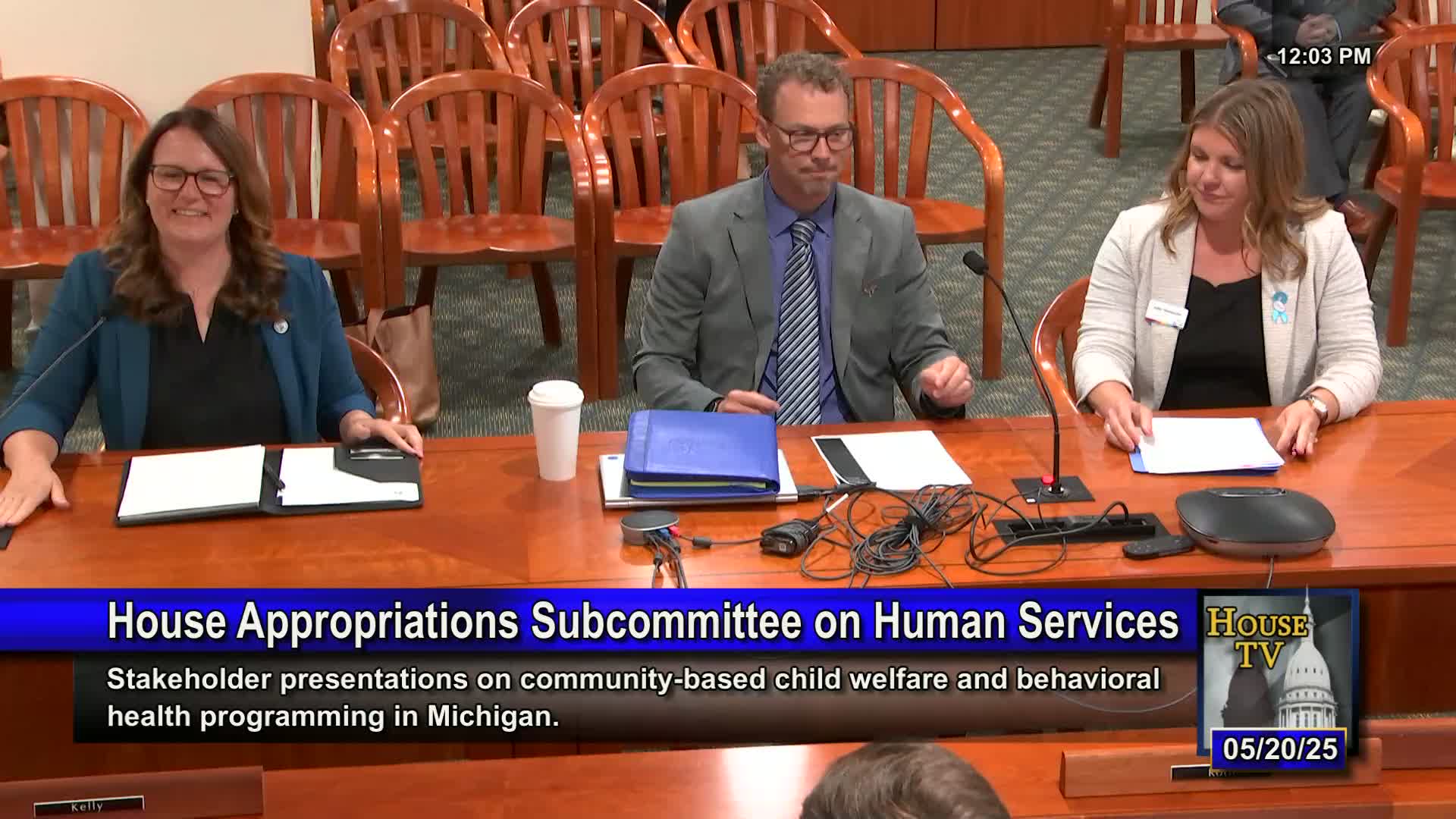
Summary
Nonprofit child-welfare providers told the House Appropriations Subcommittee on Human Services that current contract rates and workforce supports fall short of costs for adoption support, foster care per diems, family preservation and independent living programs, and urged lawmakers to fund specific increases and contract COLAs.
Representatives of the Michigan Federation for Children and Families and two of its member agencies told the House Appropriations Subcommittee on Human Services that state contract rates and workforce supports are not covering the actual cost of child-welfare services and urged lawmakers to fund adoption supports, close a foster care funding gap and add cost-of-living adjustments to provider contracts.
The testimony, given to the subcommittee by Katie Prowt, chief strategy officer of the Michigan Federation for Children and Families, Jason Schroth, chief operating officer at Wellspring Lutheran Services, and Julie Thomasma, chief executive officer at Child and Family Charities, emphasized that budget decisions for the Department of Health and Human Services affect services statewide and the nonprofit organizations that provide most of those services. "Every budget decision that you all and your colleagues are making echoes through the lives of Michigan's children," Prowt said.
Providers asked the subcommittee for several specific funding actions. The Federation supports the governor's executive budget recommendations for $4,900,000 in adoption support services and $1,900,000 for Independent Living Plus programming for older youth; members also sought increases to administrative per diems for foster care, a proposal to close an $11.5 million funding gap for family preservation and related services, and a built-in cost-of-living adjustment in contracts so providers do not have to request increases annually.
Jason Schroth described the role of family preservation services, a time-limited, home-based program that Wellspring calls Families First of Michigan. "Over 90% of the families we work with at the end, the kids are still at home," Schroth said, citing the program's effect in keeping children with their parents and avoiding higher-cost out-of-home placements. Schroth also referenced a state-contracted cost analysis by PCG that found family preservation services were being funded at about 45% of actual cost and said providers are requesting action to close an $11.5 million shortfall.
Julie Thomasma called the change in the system affecting older youth "a crisis," noting residential treatment capacity has fallen from about 990 youth in 2019 to about 314 today and many youth have been moved into Independent Living Plus programs that carry intensive needs. Child and Family Charities said one such program, Angel House in Mason, operates at a current rate of about $210 per day and providers contend that rate is two to three times below what PCG recommends for appropriate funding.
Witnesses and lawmakers also discussed behavioral health workforce shortages and the need to include nonprofit clinicians in loan-repayment programs the department has established to attract and retain behavioral-health clinicians. Prowt said many Federation members provide behavioral health services across all 83 counties, including clinic and home-based care, and noted expansion of certified community behavioral health centers (CCBHCs) in Michigan. Providers warned that a redesign and rebid of PIHP (prepaid inpatient health plan) contracts is underway and asked to be included in discussions to avoid service disruption.
Panelists described several contract and rate issues the subcommittee pressed on: the state moved a foster care administrative per diem from $55.20 toward $60.20 after provider advocacy and a lawsuit; providers said some contracts initially withheld portions of the increase behind performance benchmarks, creating confusion until recent moves to pay the $60.20 rate. As of May 16, witnesses said about 9,977 children were in foster care in Michigan.
Committee members asked for more detail on adoption rates, why new rates only apply to children referred after Oct. 1, and for clarification on how providers are compensated for long-term adoption work for youth who are "unmatched." Thomasma explained the department adjusted the method of payment to support per-diem funding for some adoption work and to better compensate agencies for children who have been difficult to match and historically had been unpaid for long case work.
No legislative action or vote on funding was taken at the hearing; the only formal action recorded during the meeting was approval of minutes from a prior meeting. The providers left committee members with requests for one-time and ongoing funding to align contract rates with PCG cost findings, to embed a COLA in provider contracts and to expand loan-repayment access for nonprofit behavioral-health clinicians, and committee members signaled interest in follow-up information and engagement with providers during any PIHP redesign.
Looking ahead, providers asked appropriators to consider the fiscal and child-welfare impacts of underfunding community-based contracts, arguing that higher investments in family preservation and community care reduce more costly foster- and residential-care placements and support longer-term outcomes for youth.