
University of Michigan economists say tariffs will slow growth despite solid near-term momentum
Get AI-powered insights, summaries, and transcripts
Subscribe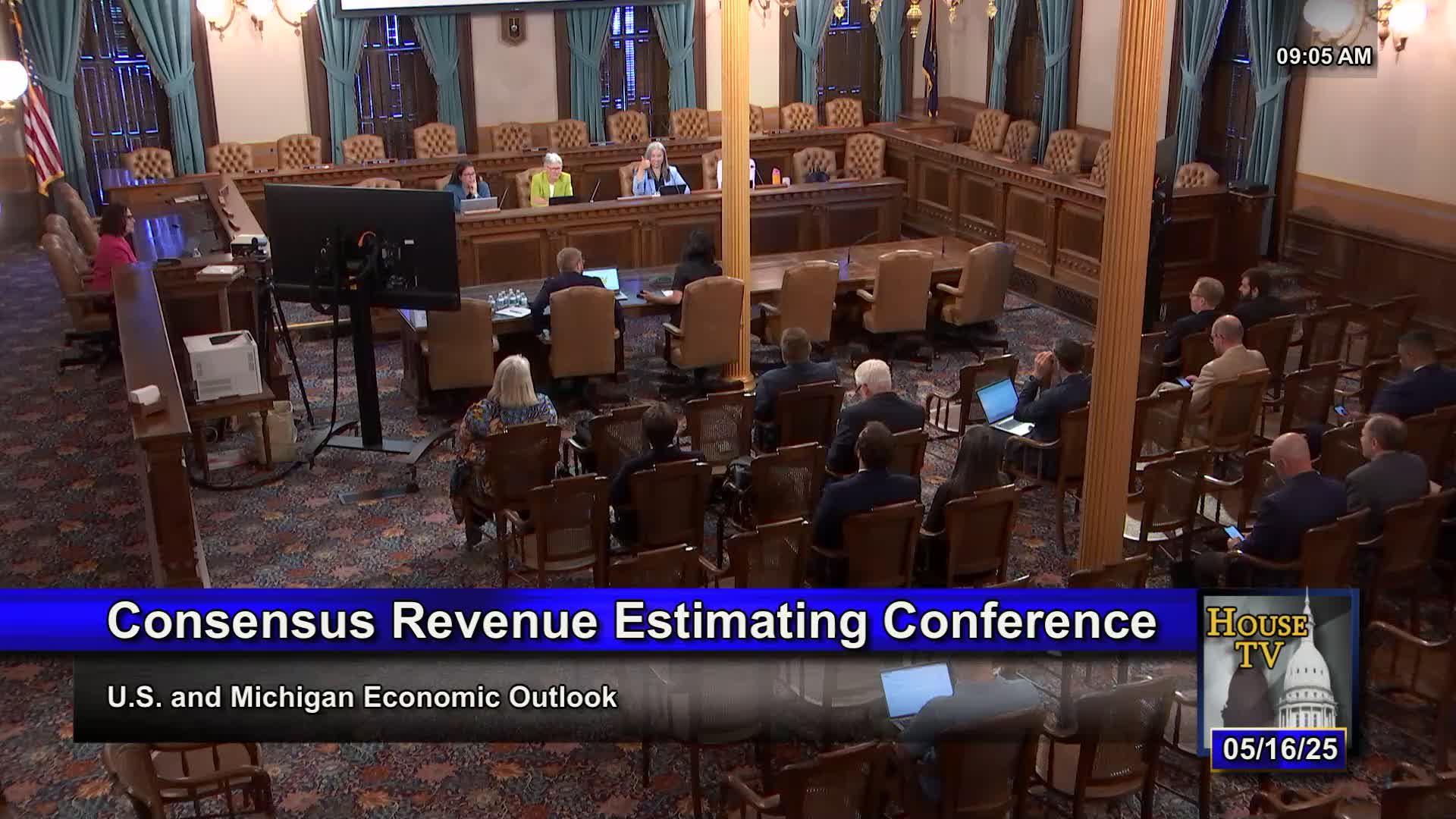
Summary
University of Michigan economists presented a forecast showing a modest national rebound this year but material downside risk from broad tariffs; Michigan'specific growth will be weaker and the state's labor market is cooling, the presenters said.
Yinyu Zhang, senior economist at the University of Michigan Research Seminar in Quantitative Economics (RSQE), told the Consensus Revenue Estimating Conference on May 20 that the U.S. economy entered the quarter "in a decent shape" but that broad-based tariffs are expected to impose a meaningful drag beginning in the third quarter.
Zhang said the RSQE baseline projects a return to modest positive GDP growth later this year, with quarterly annualized growth near 1.3 percent in coming quarters and calendar-year growth for 2025 falling roughly in half from 2024. "We expect tariffs to start affecting consumption and business investment this summer," Zhang said during the presentation.
The RSQE forecast shows headline CPI and core measures easing earlier this year before tariffs push quarterly core inflation higher later in 2025. Zhang said the center's tariff assumptions raise the effective tariff rate to roughly 18 percent nationally and produce a near-term 0.9 percentage-point jump in the PCE price level and a 0.8 percentage-point reduction in year-over-year real GDP growth by mid-2026 compared with a pre-tariff trend.
Gabe Ehrlich, director of RSQE, presented Michigan'specific projections. Ehrlich said statewide payroll gains have slowed since 2024 and Michigan's unemployment rate rose from 4.0 percent at the start of 2024 to 5.5 percent in April 2025. "All 83 counties in Michigan had a higher unemployment rate in January 2025 than in January 2024," Ehrlich said.
Ehrlich said RSQE expects Michigan employment to be essentially flat through the last three quarters of 2025, with job gains returning in 2026. The center's baseline projects Michigan payroll employment roughly 2.4 percent above its pre-pandemic level by the end of 2027 but still 3.1 percent below the all-time peak.
The presenters emphasized uncertainty: Zhang noted that news-driven policy uncertainty has spiked and that business expectations have not risen commensurately. Ehrlich cautioned that tariff details and potential supply-chain responses make Michigan's outlook especially uncertain.
The RSQE materials cited in the presentation and that are publicly available on Michigan's CREC website include the forecast assumptions and scenario projections for inflation, employment and motor-vehicle sectors, which the presenters used to construct the state and national revenue outlooks for the CREC principals.
The conference will use the RSQE forecasts together with other agency inputs in the consensus revenue agreement the principals adopt.