Get Full Government Meeting Transcripts, Videos, & Alerts Forever!
Get email alerts on the Urban Agriculture topic
No spam. Unsubscribe anytime.
Urban agriculture advocates ask Boston to increase Grow Boston staff and grassroots funding to speed projects and add open space
Summary
Neighborhood groups and urban‑agriculture organizations urged the council to boost staffing and grassroots project funds for Grow Boston to reduce land disposition delays, deliver new food‑forest parks and increase cooling green space in neighborhoods facing heat inequity.
Several neighborhood advocates and leaders in Boston’s urban‑agriculture network testified at the MOH budget hearing that Grow Boston needs more staff capacity and dedicated grassroots funding to accelerate parcels through disposition and into community use.
Orion Kriegman, executive director of the Boston Food Forest Coalition, described the climate and equity rationale for more open space and said low‑canopy neighborhoods suffer higher summer temperatures. ‘‘I'm strongly advocating for fully funding Grow Boston in the grassroots program…increase the staff capacity in Grow Boston program for timely land disposition processes,’’ Kriegman told the committee.
Alex, associate director at the Boston Food Forest Coalition, and Liz Luclous, director of engagement and food forest construction for the coalition, also requested more staff and a doubling of grassroots funding per project so neighborhood groups can move delayed projects at 301 Norfolk Street, 82 Mascot Street, Wentworth Street and Codman Square into construction. Alex said limited city capacity and small staff teams were a major cause of project delays and urged the council to invest in additional permanent staff for the program.
The nut graf: Witnesses argued that Grow Boston’s projects — community gardens, food forests and raised beds — deliver neighborhood cooling, food access and community benefits and can be built more quickly if the city increases the program’s staffing and the per‑project grassroots grants.
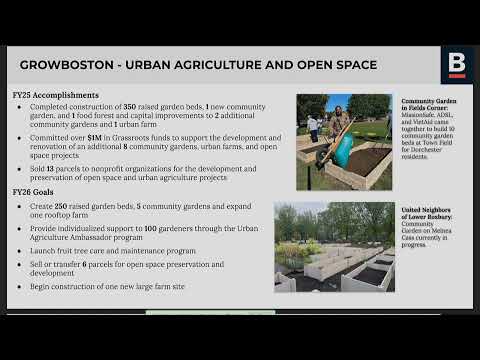
Speakers pointed to recent production numbers cited by MOH (Grow Boston completed 350 raised beds and committed more than $1 million to projects in FY25) and asked the council to make grassroots funding more robust and to prioritize timely land dispositions that already have community support.
Ending: Advocates asked the council to add staff capacity and to double grassroots grant funding per project in the FY26 budget, and to work with MOH to accelerate land transfer processes for community gardens and food‑forest parks.