Get Full Government Meeting Transcripts, Videos, & Alerts Forever!
Get email alerts on the Budget Federal Funding topic
No spam. Unsubscribe anytime.
Mayor’s Office of Housing presents FY26 budget and warns federal HUD changes could threaten programs
Summary
Boston’s Mayor’s Office of Housing outlined a $52.1 million FY26 operating budget and said recent federal actions — and new conditions on HUD grants — risk funding for homelessness and housing programs unless challenged in court and by advocacy.
Sheila Dillon, chief of housing for the city and director of the Mayor’s Office of Housing, presented the office’s recommended FY26 operating budget and a summary of work completed in FY25, and said the office is preparing to sustain services despite federal uncertainty. ‘‘Last year, we permitted 816 new, income restricted units,’’ Dillon told the City Council committee, and the office is ‘‘targeting to permit over a thousand new affordable units’’ in FY26 based on its pipeline.
Rick Wilson, director of administration and finance at the Mayor’s Office of Housing, gave the numerical overview and said the FY26 recommended operating budget totals $52,100,000, ‘‘which is a decrease of 3,500,000.0 or 6.3% from our FY '25 budget.’’ He explained the reduction reflects the removal of one‑time investments and accounting changes, not cuts to staffing or core services.
The nut graf: City housing officials said that while Boston’s municipal funding and ARPA commitments have helped scale programs, most of MOH’s budget depends on external federal grants and other outside sources. Staff signaled that changes to HUD grant rules and the president’s federal “skinny” budget — which proposed eliminating or cutting several HUD programs — could undermine homelessness and affordable housing services unless federal allocations and legal challenges preserve current funding.
Wilson told councilors MOH expects about $97 million in HUD grants and another $52 million from other external sources in FY26, bringing the office’s external budget near $150 million. He also reported that MOH secured $48,000,000 in HUD Continuum of Care funding this year and said the city committed and is spending $237,000,000 from ARPA for housing projects.
On federal policy, Wilson said MOH joined other jurisdictions in litigation contesting new HUD grant terms and that the city obtained a temporary restraining order halting enforcement of those changes. ‘‘We were successful a few weeks ago in getting a temporary restraining order, prohibiting the administration from enforcing those terms,’’ Wilson said, and added MOH expects to continue advocacy with the congressional delegation if the federal budget framework proposed by the White House proceeds.
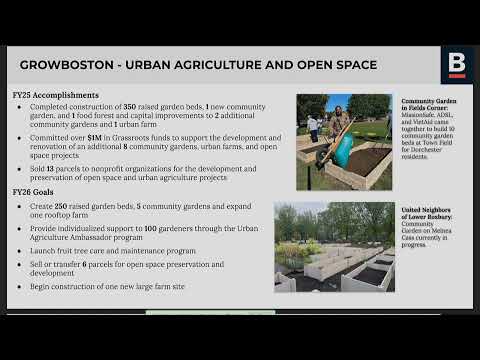
MOH also described program goals for FY26: placing approximately 1,000 people experiencing homelessness into permanent housing, serving more than 680 people living with HIV/AIDS, and housing at least 115 young adults. The presentation noted ongoing initiatives — from the Boston Home Center’s first‑time buyer support to Grow Boston’s urban agriculture projects and the Boston Energy Saver effort tied to Mass Save resources — that MOH said rely on steady external funding.
Ending: City housing officials urged continued municipal support and federal advocacy. Wilson told the council that if proposed federal cuts occur they will ‘‘severely impact our ability to create and preserve affordable housing’’ and asked councilors and partners to press congressional representatives and other stakeholders to protect HUD programs the city depends on.