Get Full Government Meeting Transcripts, Videos, & Alerts Forever!
Get email alerts on the Metro Arts Grants topic
No spam. Unsubscribe anytime.
Metro Arts details FY25 grant awards, unpaid payments and status of a promised disparity study
Summary
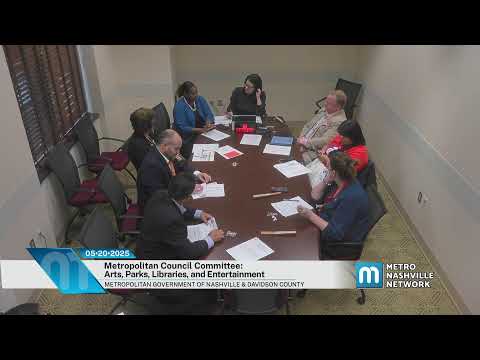
Ashley Batchelder, interim executive director of Metro Arts, told the Arts, Parks, Libraries & Entertainment Committee that Metro Arts had distributed most FY25 grant dollars but that six grantees remained unpaid and a council-funded disparity study had not been completed.
Ashley Batchelder, interim executive director of Metro Arts, told the Arts, Parks, Libraries & Entertainment Committee that the agency had distributed the bulk of its FY25 grants but that several payment and programmatic questions remained, including an unresolved disparity study the council had funded.
Batchelder said Metro Arts funded 90 organizations with general operating support in the FY25 cycle and distributed awards that ranged "from about $1,000 to $66,000 this year." The agency also funded 75 Thrive project grants. Batchelder described the grant model as revenue-sensitive for operating awards and said Thrive grants were prioritized in this cycle, which resulted in somewhat smaller operating awards than in prior years.
On fiscal sponsorships for individual artists' Thrive awards, Batchelder said 59 of the 75 Thrive projects used fiscal sponsors and those projects worked with 33 unique fiscal-sponsor organizations. She said fiscal sponsors may charge administrative fees of up to 10 percent; "22 projects had no fee at all charged to them" while some sponsors charged the maximum 10 percent.
Batchelder told the committee the first grant payments were issued on April 18 and Metro Arts had distributed approximately $3.1 million of its $3.2 million grant pool, with remaining payments delayed by vendor, contract or onboarding issues. When asked about unpaid checks, Batchelder said "there are 6 that have not been paid" and enumerated reasons including unsigned contracts, vendor onboarding problems, and a check sent to the wrong address that had to be cancelled and reissued. She said many vendor issues were corrected the prior week and staff were continuing to work with grantees to resolve outstanding payment problems.
Committee members pressed Batchelder on outreach and application counts. Batchelder acknowledged that the number of funded projects this year (75) was lower than a prior year's application pool (about 200 applications in a previous cycle) and said that some applicants withdrew, failed technical review, or did not update applications during a long inactivity period. She said Metro Arts plans continued community outreach and engagement sessions and will use the commission's policy decisions to shape future funding distributions.
A separate point of contention was a council-funded "disparity study" intended to examine procurement and participation benchmarks. Batchelder told the committee she did not have a timeline for completing the disparity study and that the commission had not completed it in the past year; Reverend Tucker of the Metropolitan Human Relations Commission (MHRC) told the committee he and MHRC "were never in agreement with that" study when it was proposed and warned that a disparity study is a legal procedure that "can often work for you and against you." Council Member Bradford asked whether an allocated amount (discussed at $250,000 in committee remarks) had been spent; Batchelder said she believed the funds "have not been used for anything else" but that she would check whether the money remained in the arts administrative account or had reverted to general funds and report back.
Batchelder also provided a timeline for the next grant cycle: the Metro Arts commission will consider guideline approval on June 26, and Batchelder projected bringing guidelines to the council for approval in July; she emphasized that awarding and contracting steps depend on guideline passage and fiscal-year close-out requirements. She reminded the committee that project spending periods and reporting must align with the fiscal year (the project spending period ends June 30 and reports are due in July) and that staff were cautious about granting extensions because of fiscal-year closeout rules.
The committee asked the Metro Arts director to return with additional details on the disparity-study funding, outstanding payments, and community outreach plans at a subsequent committee meeting.