Get Full Government Meeting Transcripts, Videos, & Alerts Forever!
Get email alerts on the Public Service Loan Forgiveness topic
No spam. Unsubscribe anytime.
Public commenters tell Education Department to preserve and expand PSLF and income-driven repayment
Summary
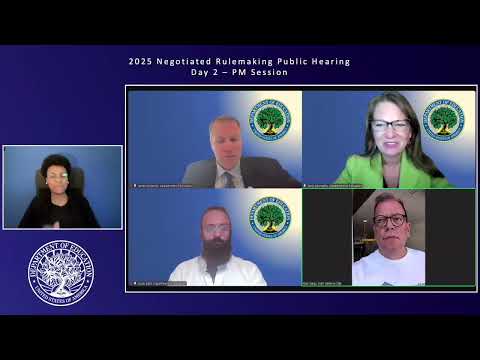
Dozens of borrowers, legal advocates, health‑care workers and university officials told the U.S. Department of Education in a virtual public hearing that preserving Public Service Loan Forgiveness and affordable income‑driven repayment plans is essential to keep people in public service and to prevent widespread borrower hardship.
Dozens of borrowers, legal advocates, health-care workers and university officials told the U.S. Department of Education in a virtual public hearing that preserving Public Service Loan Forgiveness and affordable income-driven repayment plans is essential to keep people in public service and to prevent widespread borrower hardship.
The commenters said recent actions — including litigation and an injunction affecting the SAVE regulations, forced administrative forbearance, and delays or errors by loan servicers — have left many borrowers confused, financially stressed and near default. "Maintaining affordable IDR options and broadening access to PSLF are of the utmost importance," said Amanda Pursune, director of public interest financial support at the University of California Berkeley School of Law, speaking in her individual capacity.
Why it matters: Borrowers and workforce advocates said weakening PSLF or removing affordable IDR plans would push workers out of lower‑paid public service careers — including teachers, nurses, social workers, first responders and public defenders — and would worsen staffing shortages in sectors that rely on those workers. Commenters also described personal harms from implementation failures: interrupted credit toward forgiveness, months lost to administrative forbearance, long servicer backlogs and unclear timelines for buyback or recertification.
Most speakers urged the department to delay major regulatory changes until congressional action or litigation is resolved and to take administrative steps to stabilize service and access. "Changing these rules on borrowers now ... threatens to create unnecessary disruption and stress for borrowers," said Abby Shaffroth, director of the Student Loan Borrower Assistance Project at the National Consumer Law Center. Several commenters asked the department to preserve existing payment caps in statute or regulation (for example, capping payment at 10 percent of discretionary income) and to keep or restore repayment plans such as ICR and PAYE that many long‑term borrowers rely on.
Borrowers described concrete harms. Brian Brown, a school teacher from Riverton, Wyoming, said his account entered administrative forbearance while he was 29 payments from PSLF and that a later cancer diagnosis has made the difference between an affordable plan and financial catastrophe. "If the Department of Education denies loan forgiveness and strips away the SAVE and PAY programs, many Americans will share my likely fate," he said. Other commenters said they had waited months for IDR applications or buyback requests to be processed and that servicer mistakes and low staffing made reaching servicer representatives difficult or impossible.
University and state officials framed PSLF as a workforce policy as well as a borrower protection. Jana McKay, director of educational debt counseling at Oregon Health & Science University, said PSLF has helped the university community secure millions in forgiveness and is a "social contract" that enables professionals to pursue lower‑paid public service specialties. Dolores Nikolai, principal loan and contract analyst at the University of California Office of the President, said narrowing employer eligibility would risk losing staff to the private sector and could worsen shortages in nursing, policing and teaching.
Several commenters warned against tying nonprofit employer eligibility to new subjective criteria. Student advocates and state ombudsmen pointed to the Higher Education Act and to 20 U.S.C. §1087e (the law that defines PSLF eligibility) in arguing that the department lacks authority to create discretionary carve‑outs for organizations that meet existing tax‑exempt definitions. "The law is clear ... full‑time waged employees are eligible for PSLF, full stop," said Spencer Dixon, a state employee and borrower pursuing PSLF.
Recommendations from commenters included: delay negotiated rulemaking until litigation and pending congressional proposals are resolved; grandfather existing borrowers into their current repayment plans; preserve or restore ICR and PAYE where they serve as the only viable path to forgiveness; automate employment and income verification; improve servicer staffing, training, and oversight; and process buyback and forgiveness applications more quickly and transparently.
Department staff closed the hearing by saying the department will consider the comments and that a separate notice requesting nominees for negotiated rulemaking would be published; staff encouraged continued written submissions to Regulations.gov. The hearing record contains dozens of personal testimonies illustrating both the policy stakes and the operational problems borrowers face.
The public hearing provided the department with extensive anecdotal evidence about effects on borrowers and public‑service hiring decisions, but it did not include formal rule changes or votes. The department will next review written comments and proceed through its rulemaking and outreach processes.