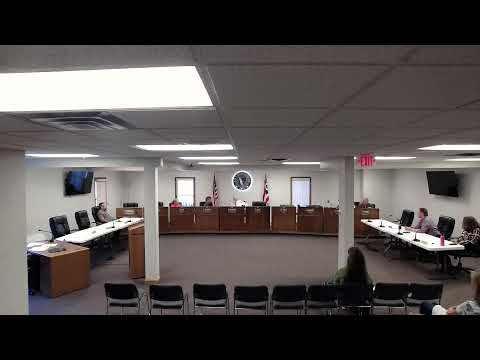
Pataskala panel backs code rewrite to define, regulate extended‑stay hotels
Summary
The Development Committee recommended launching a formal code‑amendment process to add definitions and development standards for hotels and extended‑stay hotels, including a public water/sewer requirement, parking and lighting rules, and a certificate of compliance. The changes will go to the Planning & Zoning Commission for review.
The Pataskala City Development Committee voted to recommend that the city begin a formal code amendment process to create new definitions and development standards for hotels and extended‑stay hotels, including a requirement that extended‑stay properties connect to public water and sewer and obtain a certificate of compliance.
The committee’s action moves a package of redlined changes — new definitions for “dwelling hotel,” a revised definition of “hotel” (transient stays of 30 days or less), and a definition for “extended stay hotel” (stays longer than 30 days regardless of short leases) — into the Planning & Zoning review stage. Committee members said the rewrite is intended to prevent properties marketed as hotels from operating like apartments.
Mikaela Heaven, the city planner, presented the redlines and said the extended‑stay definition mirrors state regulations and is intended to capture residential hotels and extended‑stay operators that provide living, eating, cooking, sleeping and sanitation facilities in a single unit. She also said the draft would add extended‑stay hotels as a conditionally permitted use in the multifamily residential district and point to Chapter 12‑77 for additional requirements. “These would not address Airbnb,” Heaven said, noting short‑term rental enforcement remains a separate issue the city will need to address.
Under the proposed changes, multifamily and extended‑stay developments would be required to connect to public water and sewer service — specifically to be customers of Pataskala utilities or the regional water district — though the presentation acknowledged some existing multifamily structures might be grandfathered. The draft code sets minimum dwelling‑unit size standards (to distinguish small hotel suites from full apartments), carries forward building‑appearance and sign rules, and adds hotel‑specific development standards into a renumbered Chapter 12‑77 for “Hotels and Extended Stay Hotels.”
The amendments also carry several operational and design standards: parking and loading requirements were updated to include extended‑stay hotels; parking‑lot lighting would be limited to no more than 8 feet in height and require concealed light sources; and fenestration (windows) and other appearance standards were retained from the existing code. Noise and off‑site impacts would continue to be governed by the city’s off‑site impact provisions in Chapter 12‑87, the planner said. The draft replaces a variety of older, scattered hotel rules with a consolidated article and includes an inspector designation (city administrator or designee) and a certificate of compliance requirement.
A councilmember moved that the Development Committee recommend the ordinance amendments be sent through the code amendment process to Planning & Zoning and then back to council; the motion was seconded and the committee approved the recommendation. The planner said the recommendation will start the formal public process, including Planning & Zoning review and subsequent council hearings.
The committee asked staff to preserve public‑utility connection language and to clarify minimum unit sizes and enforcement mechanisms as the draft proceeds through the formal amendment process.
AI generated
The text on this page is AI generated. Summaries, highlights, analysis, and video transcripts are all produced from the original source material.
AI can make mistakes, so if you spot one, and we will fix it for everyone.
Note: the source content is unaltered by us. Any content source we link to, be it a video, an audio recording, or a document, is presented exactly as its publisher released it. That publisher is usually a government body, sometimes an individual official or another organisation.