Get Full Government Meeting Transcripts, Videos, & Alerts Forever!
Get email alerts on the Teacher Compensation topic
No spam. Unsubscribe anytime.
Teachers, union and administrators spar over pay; district unveils proposed pay bumps and hard‑to‑fill range
Summary
Oak Creek‑Franklin Joint School District board members heard multiple public comments May 19 urging predictable teacher pay and good‑faith bargaining, while administrators outlined a compensation plan that would raise teacher minimums and create a separate pay range for hard‑to‑fill positions.
Oak Creek-Franklin Joint School District board members heard multiple public comments May 19 urging predictable teacher pay and good‑faith bargaining, while district administrators outlined a proposed compensation plan that would raise teacher minimums and create a separate pay range for hard‑to‑fill positions.
Union leaders, longtime teachers and community members said the district’s bargaining approach has been dysfunctional and demoralizing. “The urgent need for good faith bargaining on teacher salaries,” said Alec Elfenbein, president of the Oak Creek Education Association, as he urged the board to “come to the table and prepare for meaningful salary discussions.” Terry Grogan, vice president of the Oak Creek Education Association and a special education teacher, told the board teachers have lost purchasing power since 2011 and cited district surpluses as evidence the district can afford increases: “The district looks to be in very good shape and could easily afford to give… a salary increase to match the CPI of 2.5% next year would cost just over a million dollars.”
Ted Craig of the Wisconsin Education Association Council said bargaining sessions have repeatedly opened with an offer of “0” from administration: “When we schedule a bargaining session, management… shows up and says, we’ve already decided what is gonna happen as far as your pay. And what we’re offering here is 0.” He told the board the practice harms morale and retention.
On the administration side, Troy Hamlin (district administrator) presented the district’s compensation plan. Key elements described in the presentation include a $1,000 increase to teacher minimums and the teacher fourth‑year step, higher hourly add‑ons, creation of a new pay range for “hard‑to‑fill” teacher positions (listed in the presentation as technical education, family and consumer science, science, business and special education) and $2,000 stipends tied to PBIS work funded through Title IV federal funds. Hamlin said the hard‑to‑fill range targets primarily teachers in their first four years of service and is intended as a pilot to reduce mid‑year vacancies that have often proved difficult to fill.
Board members and administrators framed the pay discussion as part of multi‑step budget planning. The district’s business reports shown at the meeting noted recent surpluses and interest revenue; speakers cited a prior year surplus of about $3,800,000 and cumulative post‑2011 surpluses “nearly $12,500,000,” with interest income of roughly $1,100,000 last year. Administrators also outlined an accounting change related to HRA forfeitures—about $400,000—that will require a budget adjustment to reclassify revenue and expense.
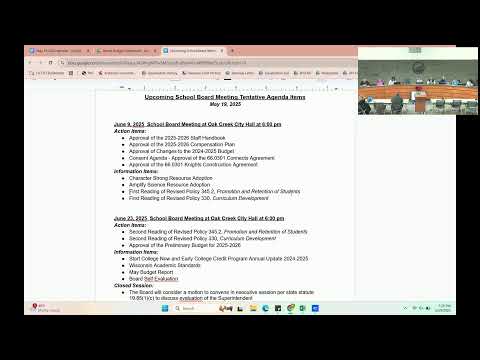
No formal change to bargaining protocol was adopted at the meeting. The board did not vote on the compensation plan; Hamlin said the plan and related employee handbook changes are scheduled for action at the June 9 meeting. In the meantime, multiple public speakers asked the board to intervene in bargaining so teachers and administration can negotiate in good faith.
Discussion versus action - Discussion: Multiple public comments from union leaders and teachers described long‑running bargaining concerns, loss of salary value since 2011, and requests for a predictable salary schedule. Administration described the proposed compensation plan and the budget context. - Direction/Next steps: Administration presented the compensation plan for board consideration and scheduled action items (compensation plan and staff handbook) for the June 9 meeting. Hamlin said stipends funded by Title IV would be considered temporary and that staff would be notified those payments depend on federal funding. - Formal action at this meeting: None on the compensation plan; the agenda and personnel items were approved (see separate article on personnel). The board will consider compensation and handbook approvals June 9.
Why it matters Teachers and bargaining representatives said predictable pay and functioning collective bargaining are critical to retention and instructional continuity. Administration counters that the district is recommending targeted pay moves and new pay ranges to address staffing shortages in specified areas, but final approval depends on upcoming board votes and budget adjustments.
Ending note Board meeting materials and public speakers cited specific budget figures and a timeline for action: administration will bring compensation and handbook approvals to the board on June 9, and union representatives said they will continue to press for a transparent salary schedule and collaborative bargaining process.