
Judge Stephanie Boyd instructs jury pool in State v. Darren Johnson
Get AI-powered insights, summaries, and transcripts
Sign Up Free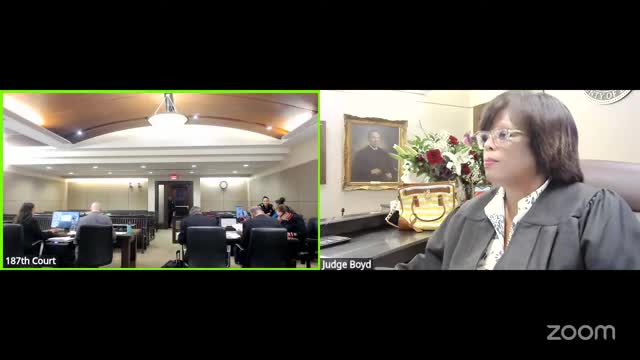
Summary
During voir dire in State v. Darren Johnson, Judge Stephanie Boyd instructed the jury pool on indictments, presumption of innocence, the right to remain silent, burdens of proof and sentencing ranges for aggravated assault and injury to the elderly.
Judge Stephanie Boyd of the 187th District Court addressed a seated jury pool at the start of jury selection in State v. Darren Johnson, reminding prospective jurors of their duties and legal standards in criminal trials.
The judge told the panel the indictment is only “a piece of paper” to notify a defendant of charges and “is not to be considered as evidence,” and explained the right to remain silent and the presumption of innocence. She instructed jurors the State must prove guilt “beyond a reasonable doubt” and said jurors must not substitute civil standards such as “more likely than not.”
The case is presented on two counts: count 1, aggravated assault with a deadly weapon; and count 2, injury to an elderly person. Boyd recited statutory sentencing ranges cited in court: count 1 carries a possible prison term of 2 to 20 years and count 2 a possible 2 to 10 years, and she told jurors the possibility of probation is part of that range.
Prosecutors Megan Galloway and Andrew Adelman announced for the State; William Davidson and Robert Porter announced for the defense and identified Darren Johnson as the defendant. Boyd explained courtroom procedures for voir dire, including how jurors should signal questions, and repeatedly stressed that attorneys may only discuss hypotheticals during selection and cannot tell jurors what the facts of the case will be.
Throughout voir dire the judge and attorneys asked about potential biases, language accommodations, scheduling conflicts and attitudes toward law enforcement, burden of proof and sympathy for defendants. Boyd directed the panel on the difference between the guilt phase and, if necessary, a separate punishment phase, and reminded jurors that sympathy may not factor into a verdict.
The court paused voir dire at intervals for short breaks and to handle unrelated docket matters; Boyd told jurors she expects the trial proceedings will conclude within the week if selected. Jurors were instructed to return when called and to follow courtroom procedure during breaks.