Get Full Government Meeting Transcripts, Videos, & Alerts Forever!
Get email alerts on the Public Safety Dispatch Grant topic
No spam. Unsubscribe anytime.
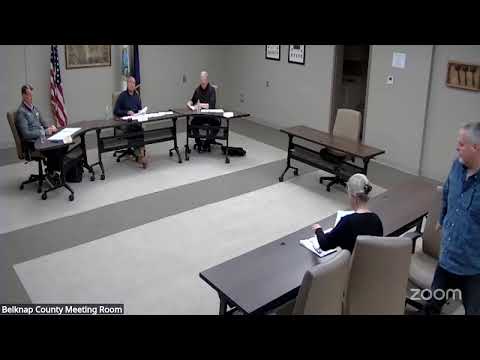
Belknap County sheriff reports dispatch upgrades, joins ICE 287(g) program; commissioners accept highway-safety grant
Summary
Sheriff Bill told the Belknap County Commissioners that his office has completed major radio and dispatch upgrades, is participating in the federal ICE 287(g) program for warrant service, and that the commissioners voted to accept the 2026 New Hampshire Highway Safety Grant.
Sheriff Bill told the Belknap County Commissioners that his office has completed major radio and dispatch upgrades, is participating in the federal ICE 287(g) program for warrant service, and that the commissioners voted to accept the 2026 New Hampshire Highway Safety Grant.
The update matters, Bill said, because the changes improve regional dispatch interoperability and provide reimbursed overtime and equipment funds for traffic-enforcement operations during high-demand periods such as Bike Week.
Sheriff Bill said the department currently has “51 employees on the roster,” a mix of sworn deputies, bailiffs and civilian staff. He described recent technology projects: two simulcast LMR radio channels plus one simplex channel now operational; a consolidated computer-aided dispatch (CAD) connection with nearby agencies; and a rebuilt dispatch center with three fully functional terminals and a fourth terminal being set up. “We’re fully operational with 2 simulcast LMR, radio channels, and we have 1 simplex radio channel,” he said. He told commissioners the data-conversion work for historical CAD records is “scheduled and targeted to be completed by September 2025.”
Bill described the county command post as retrofitted and already used by neighboring departments during events. He said a new magnetometer and X‑ray machine were installed at the courthouse entrance and that camera replacement remains on the Administrative Office of the Courts’ queue.
On grants and reimbursements, Bill reported specific revenue and pending reimbursements: $26,602.50 in outside-detail revenue to date; about $95,000 in port-security reimbursement; roughly $5,300 in New Hampshire Highway Safety overtime reimbursement; more than $38,000 in mobile-data-terminal reimbursements; and an expected $18,960 in highway-safety radar reimbursement. The sheriff also said the office is participating in the New Hampshire Highway Safety Grant program and that commissioners voted to accept the 2026 grant. “That doesn’t start till October,” he added.
The sheriff described participation in the federal ICE 287(g) program as limited and narrowly scoped to warrant service. “We’re basically conducting the warrant services,” he said, adding that only full‑time deputies who have taken the training and the sheriff will perform those duties. He stressed local practice and limits: if a detainer appears during a motor-vehicle stop, local officers should not handcuff or transport; instead the sheriff’s office will send a 287(g)-certified deputy to affect warrant service and transfer custody as needed. He said the training was a 40‑hour online course and that, based on the training, program practice differs from some media characterizations: “what I read and what I see in the mainstream media is completely opposite of what ICE is teaching us and what ICE is requiring us.”
Commissioners asked about reimbursement and overtime for ICE work; Bill said the county will not send deputies off-hours unless ICE or another agency agrees in advance to reimburse overtime and that a formal agreement or memorandum of understanding would be required before expanded after‑hours participation.
Statistical and operational notes from Bill included that the communications division has logged over 55,000 call‑related entries and that the county fleet has 12 patrol vehicles (10 fully outfitted, two pending installation). He said training continues for dispatch and emergency management, and that the upgraded dispatch center will be opened for a public dedication once fully optimized.
Action: Commissioners moved to accept the 2026 New Hampshire Highway Safety Grant as presented; the motion passed with the vote recorded as unanimous (tally: yes 4, no 0, abstain 0). The sheriff noted the grant funding and associated activities will begin in October and that the chair’s signature is required to finalize county acceptance.
Discussion-only items included the ongoing CAD data conversion and planned interoperability connections with additional agencies, the timing of camera replacements (dependent on the Administrative Office of the Courts), and plans for an open house for the dispatch center. Direction: the sheriff said he will invite commissioners to the dispatch dedication and coordinate any required memoranda of understanding for outside-agency reimbursements.
The sheriff referenced state and federal authorities, and he discussed coordination with neighboring county jails used for ICE holds. He identified Merrimack County and Strafford County as current holding facilities known to his office and said other counties have inquired about joining ICE housing arrangements.
Ending: Commissioners thanked the sheriff for the report. The sheriff noted he would be attending a legislative hearing in Concord on a separate county reimbursement request for court-security funding.