Get Full Government Meeting Transcripts, Videos, & Alerts Forever!
Get email alerts on the Sidewalk Snowplow topic
No spam. Unsubscribe anytime.
Staff proposes shrinking sidewalk plow routes; seeks public input before July decision
Summary
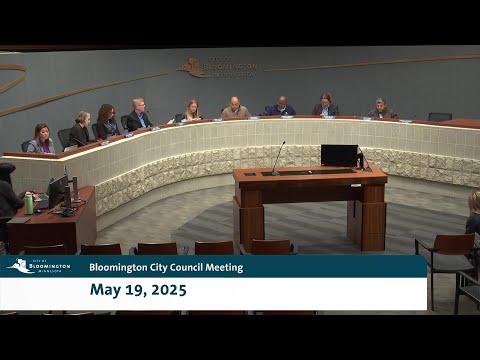
City staff presented a plan May 19, 2025, to reduce sidewalk plow route mileage and shift clearing of low‑volume sidewalks to adjacent property owners; staff cited operator safety, property damage and long route times and said it will return with a final recommendation in July after additional outreach.
City staff sought feedback May 19, 2025, on a proposal to reduce sidewalk plow route lengths in Bloomington and move clearing responsibility for some lower‑volume residential sidewalks to adjacent property owners.
Presenters Dave Hanson and plow operator Kevin Edin described sidewalk plow operations, safety risks for crews and maintenance costs. Kevin Edin told the council his survey of peer cities found that sidewalk routes in the 10–15 mile range are the most operationally successful; he said Bloomington’s current routes average roughly 25 miles per route. "In the 10 to 15 mile range, they all feel successful, able to get out there, get everything cleared within one day," Edin said.
Staff proposed a map that would keep arterials and major collectors in the city’s responsibility while turning minor collectors and local streets to adjacent property owners. Under one scenario staff presented, the city’s sidewalk routes would fall to about 13 miles each — a level the department said would allow crews to clear sidewalks in one day and then perform targeted cleanup passes.
Staff cited several reasons for the proposal:
- Safety and workforce health: sidewalk plow operators work in narrow, low‑visibility conditions that increase injury risk and mental strain; staff said workers’ compensation claims and reported injuries are higher for sidewalk routes than many other plow operations.
- Service timeliness and quality: sidewalk routes currently can take one to three days to finish; staff said reducing route lengths would improve the timeliness of sidewalk clearing and reduce rework caused by other plow operations.
- Property damage and repair costs: staff reported about 80 sod‑damage repair requests this winter and described how soft ground and indistinct snowbanks can cause equipment to track off the sidewalk and damage lawns and landscaping.
- Budget and operational opportunity costs: staff estimated equipment‑related savings of $50,000–$60,000 and about $11,000 in overtime savings; they also estimated roughly 925 staff hours could be redirected—about half an FTE—toward park maintenance and forestry work.
Equity and accessibility questions were prominent in council discussion. Staff said they plan supportive services lists for vulnerable residents, multi‑language outreach and a first‑year compliance focus on education rather than fines. They also said they had consulted the school district, which indicated it would not have capacity to take over clearing of sidewalks adjacent to school property; staff reported an estimated five miles of sidewalks adjacent to schools would remain city responsibilities.
Council members expressed a range of views. Council member Mua said Bloomington is an outlier among peer suburbs for providing widespread sidewalk plowing and argued the city should reset expectations and rely more on neighbors and property owners. Council member Rivas urged broader outreach — including recommending a mailed notice to every household — and expressed concern for residents who lack capacity to clear sidewalks. Council member Lowman asked staff to provide cost estimates for building enough capacity to maintain current service levels rather than changing the policy. Several council members asked staff to refine the draft map to avoid placing responsibility on property owners where sidewalks are effectively in private backyards or where bus stops and school walk routes would be affected.
Staff said they will continue outreach — including an online survey on Let’s Talk Bloomington and an in‑person presence at the June farmers market — and return to the council in July with a final recommendation, map refinements and possible code amendments. If adopted, staff said the city would change its sidewalk clearing code (currently enforcing a 12‑hour rule written decades ago) to a 24‑hour standard consistent with peer cities, and focus the first year on education and outreach rather than penalties.