Get Full Government Meeting Transcripts, Videos, & Alerts Forever!
Get email alerts on the Pslf Idr topic
No spam. Unsubscribe anytime.
Borrowers, health workers and educators urge Department to preserve PSLF and income-driven repayment at Title IV hearing
Summary
Scores of public commenters at the Education Department hearing urged preserving or expanding Public Service Loan Forgiveness and income-driven repayment, citing retention of nurses, teachers, prosecutors and physicians, the burdens of high debt on borrowers’ lives and calls to avoid narrowing the definition of qualifying employers.
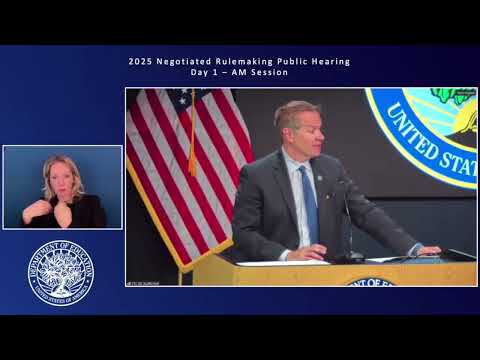
Washington — Dozens of borrowers, students, health-care workers, teachers and public servants urged the U.S. Department of Education on Friday to preserve and strengthen Public Service Loan Forgiveness (PSLF) and income-driven repayment (IDR) programs as the department begins negotiated rulemaking under Title IV of the Higher Education Act.
“Student debt forgiveness is a pathway to economic security,” said Samir Hassan of Young Invincibles, who told the hearing he carries about $125,000 in student debt and that PSLF and IDR allow him to “set money aside to make those dreams a reality.”
Speakers described the programs as critical to recruiting and retaining workers in nursing, teaching, law enforcement, emergency medical services and public defense. Charlie Smith, Frederick County (Md.) state's attorney and chair of the board of the National District Attorneys Association, said PSLF helps keep prosecutors in often understaffed offices and argued that reductions would “accelerate” prosecution shortfalls. Lynn Taylor, an internal medicine resident representing the American College of Physicians, said IDR and PSLF are the only ways many resident doctors can afford payments during training.
Several commenters warned against narrowing the department’s proposed definition of a qualifying employer for PSLF to exclude organizations that engage in a “substantial illegal purpose,” a formulation discussed by department staff. The National Association of Student Financial Aid Administrators told the department that excluding employers without a formal legal finding could create subjectivity and “empower negotiators to target organizations based on disagreements with their mission or services.”
Borrowers and advocates described the practical harms of uncertainty and administrative delay. “I completed over 10 years of public service, making payments in good faith,” said Joseph Javier Ayala, calling borrowers’ frustration “not just unfair. It’s immoral.” Several physician speakers urged that months when borrowers were placed on the SAVE injunction’s forced forbearance be credited toward PSLF or be made available for buyback without unrealistic lump‑sum payments.
Other commenters urged broader protections and modernization: employers and benefit vendors recommended interoperable application programming interfaces (APIs) and clearer rules governing third-party access to student-aid data so that employers can reliably offer loan-repayment benefits. Savvy’s chief borrower advocate recommended “investing in APIs” and creating a user-permission approach to data access.
Numbers and context cited at the hearing: the Center for American Progress noted roughly three in 10 borrowers — about 12,500,000 — were enrolled in an IDR plan; speakers also referenced roughly 43,000,000 federal loan holders overall. Multiple commenters said enrollment and forgiveness processing remain stalled because of litigation over the SAVE plan and operational backlogs on studentaid.gov.
What commenters asked the department to do
- Preserve or expand eligibility for PSLF and maintain multiple IDR plan options rather than consolidating to a single plan without safeguards. - Ensure months placed into forced forbearance during the SAVE injunction can count toward PSLF or be made payable through realistic buyback options. - Avoid a definition of qualifying employer that depends on subjective determinations of “illegal activity” without a formal legal finding or due-process mechanism. - Invest in modern data access (APIs) and borrower‑centered processing, including automatic enrollment or recertification options for IDR with borrower consent.
What the department said: Officials at the hearing acknowledged the SAVE plan’s portions were enjoined by courts and said they sought feedback on “aligning income contingent repayment, as well as the pay as you earn repayment plan with the requirements of the law.” The department also extended the written comment deadline to May 8 and said it will consider nominations for negotiated rulemaking committees.
The public comment period for rulemaking remains open, and many organizations and individuals said they will submit written comments to the department.