Get Full Government Meeting Transcripts, Videos, & Alerts Forever!
Get email alerts on the Public Safety Jail Finance topic
No spam. Unsubscribe anytime.
Bulloch County approves 20-year financing plan for jail expansion
Summary
The Bulloch County Board of Commissioners voted to issue 20-year revenue bonds to fund an expansion of the county jail after hearing financing scenarios and operational briefings on capacity and costs.
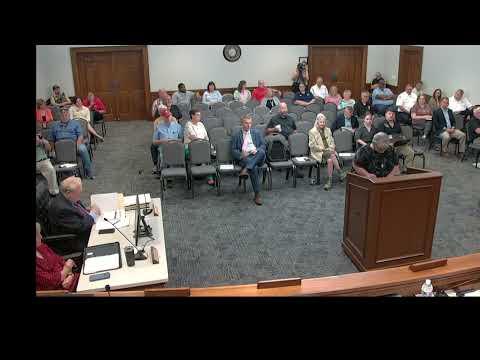
Bulloch County commissioners voted to pursue a 20-year revenue bond financing plan for a jail expansion project during their May 20 meeting, approving the financing option after discussion of alternatives, operating impacts and legal constraints.
The vote followed presentations from county legal and financial advisers and a public discussion that included the interim county manager and the correctional institute warden. County Attorney Jeff Akins told the board that the jail project was included on a recent SPLOST referendum and that “by law, you cannot abandon a project that was approved on a splosh referendum.” He added that the intergovernmental agreement contemplated issuance of revenue bonds and that the board could seek voter approval to abandon a project only through a separate referendum process.
The question before the board was whether to issue revenue bonds over 12 years or 20 years. Financial adviser Doug (Davenport) presented a cash-funding analysis showing that paying for the project solely from SPLOST collections would delay construction many years and substantially increase total cost because of construction inflation; under one pay-as-you-go scenario construction would not start for nine years and the estimated cost rose into the tens of millions. He said, “we do recommend going forward with the 20 year financing option, purely that it allows the county a lot of flexibility into the future with the ability to pay it off early in the event that there are surplus collections.”
County leaders and corrections officials described operational reasons the county must proceed. Chairman David Bennett said, “we're not building a new jail. We are expanding the jail that we have by adding an additional jail pod.” Interim county manager Randy Tillman and Warden Robert Toole explained differences between jails and prisons, the need to house a shifting pre‑conviction population, and the high baseline costs for medical care and security in a jail setting. Tillman estimated the sheriff’s general population bed capacity at roughly 443 beds and said the facility was operating near about 80% of that capacity.
Discussion highlighted tradeoffs: a 12-year bond would reduce interest expense but create greater short- to medium-term pressure on the general fund if SPLOST revenues fell short. County financial staff presented the millage‑equivalent millage impact of a shortfall under each option: if SPLOST revenues were not available as expected, the 12‑year scenario could equate to roughly 1.3 mills of levy pressure on the general fund, while the 20‑year scenario lowered that equivalent to about 0.68–0.69 mills (figures based on the current digest and assumptions presented by the county’s advisers).
Board members said they intended to pursue early payoff if revenue allowed; commissioners were told the financing can be structured so SPLOST excess collections would be applied to early retirement of the debt. Several commissioners also asked whether the bonds could be restructured later; bond counsel confirmed refinancing or restructuring would be possible although it would carry additional costs.
After discussion, a motion to approve the 12-year option failed for lack of a second. A motion to approve the 20-year revenue bond financing was seconded and passed; the motion carried with the board recording the outcome as approved (tally: yes 5, no 1). The board and staff said the county’s intention is to pursue early payoff of the bonds when feasible and to use SPLOST excess collections to reduce the outstanding balance.
County staff also briefed the board on reasons construction costs for modern jail facilities can be high, including prefabricated steel cell modules, specialized doors and locking systems limited to a few certified vendors, and additional health and safety standards that evolved from litigation and regulatory requirements. The commissioners said they would hold future boards accountable for any early-payoff commitments.
The board’s action authorizes staff and professionals to proceed with issuance of revenue bonds under the approved structure and directs county staff to continue coordination with bond counsel and financial advisers on final transaction documents. The board moved next to other agenda items.