Get Full Government Meeting Transcripts, Videos, & Alerts Forever!
Get email alerts on the Economic Development topic
No spam. Unsubscribe anytime.
Sugar Land approves up to $12.5 million in incentives to reinvest in Town Square
Summary
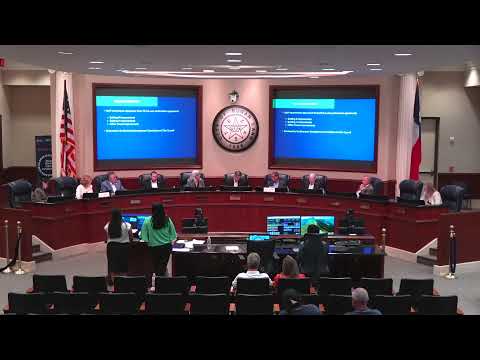
Sugar Land Development Corporation and Sugar Land 4B Corporation members approved three five‑year performance agreements on May 20 to provide up to $12.5 million in incentives for improvements and tenant incentives at Sugar Land Town Square.
Sugar Land Development Corporation and Sugar Land 4B Corporation members approved three five‑year performance agreements on May 20 to provide up to $12.5 million in incentives for improvements and tenant incentives at Sugar Land Town Square.
City staff said the package — split between the two economic development corporations — includes a $6 million modernization fund for Building B, $2 million for Building H and $4.5 million for office tenant improvements. Payments will be reimbursement‑based, tied to verified expenditures, and subject to clawback if agreement conditions are not met.
The measures were presented by Jessica Hoggle (staff member) and a second city staff presenter identified in the meeting. Hoggle summarized Town Square’s 25‑year history and the role of earlier public investment, saying the original tax increment revenue vehicle “surpassed” its projected performance and that “I would say our job here is done” with respect to the initial TIRS period. She described the recommended incentive as “an aggressive short term solution to enter or reenter a very competitive market,” and said the full proposal is intended as an initial phase in a larger vision that could include additional housing and hotel expansion in the regional activity center.
Nut graf: Town Square is a major consolidated retail, office and event center for Sugar Land. With the tax increment mechanism that originally funded the project expiring in December 2025 and office occupancy declining since the pandemic, city staff told members the city needs targeted reinvestment to keep the property competitive and preserve tax and sales‑tax revenues.
City staff gave financial and program details during the presentation. They said Town Square began construction in 2001 on a 32‑acre mixed‑use site and that the TIRS (referred to in the presentation as “TIRS 1”) had a base value of about $5.5 million and was appraised at about $196 million for the 2024 tax year. Staff said the city and its development partners previously invested tens of millions in infrastructure and improvements: the city has provided about $60 million in incentives and Lionstone (a private owner) has invested about $70 million in the property, including a $1.5 million plaza redesign for which the Sugar Land 4B reimbursed $750,000.
Staff described market trends and the rationale for the incentive: the office market has tightened, tenant demand has shifted toward higher‑quality Class A space and amenitized offices (co‑working, frosted glass, on‑site fitness with showers), and Town Square’s daytime population is smaller than when it was first built. Pennybacker, a development adviser to the property owner, proposed approximately $42 million in reinvestment to be split roughly 50/50 with the city; the council‑level recommendation approved May 20 limits the city’s committed incentive to a maximum of $12.5 million over five years and formalizes reimbursement, construction and job‑reporting requirements.
The three performance agreements require cumulative creation and/or retention of at least 650 primary jobs across the agreements, annual proof of eligible expenditures within 60 days of each agreement year, and compliance with construction and spending requirements for materials, services and equipment. Staff emphasized that incentive payments will be reimbursement‑based and include clawback provisions for failure to meet terms. On the statue‑related definition of reportable jobs, a staff presenter clarified that only “primary” jobs (those meeting the statutory definition for 4A/4B incentives) can be counted toward the contract targets: “for the statute for 4A and 4B, we are only allowed to, or we can only count primary jobs,” the staff presenter said.
Council members asked for clarifications and pressed staff on how the improvements would translate into new or retained jobs. One member questioned whether aesthetic and amenity upgrades — pocket parks, lobby refreshes and a café — would be sufficient to attract employers in a competitive market; staff replied that the proposed tenant improvement fund is intended to help bring spaces to Class A standards and that the city’s office‑attraction efforts will continue in partnership with the property’s broker and private partners.
Votes and next steps: The Sugar Land Development Corporation (SLDC) voted 6–1 to approve the three SLDC items (Building B $6,000,000; Building H $2,000,000; office tenant improvements $4,500,000). The Sugar Land 4B Corporation then took up parallel 4B items and approved them by separate voice votes (4B recorded 5 ayes where recorded). Staff said the agreements had been reviewed by the city’s economic development committee and city council and that reimbursements and reporting will be required annually under the agreements. Staff also said the action does not preclude further exploration of housing or hotel expansion in Town Square as part of a longer‑term strategy.
Ending: The performance agreements take effect subject to the terms in each contract, including verified expenditure reporting and clawback provisions; staff said they will return with implementation details, and council members emphasized continuing oversight and follow‑up on job reporting and the balance of office, retail and hospitality uses in the center.