Get Full Government Meeting Transcripts, Videos, & Alerts Forever!
Get email alerts on the Redistricting topic
No spam. Unsubscribe anytime.
Tarrant County hearing erupts over mid‑decade redistricting; critics call maps racial gerrymander
Summary
Elected officials, voting‑rights lawyers and hundreds of residents packed an Arlington hearing to oppose proposed mid‑decade redistricting plans for Tarrant County, saying the five draft maps crack and pack Black, Hispanic and Asian voters and will likely trigger costly litigation. County leaders plan a June 3 vote on the maps.
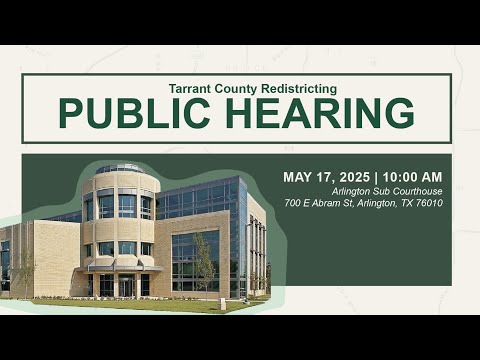
Tarrant County Commissioner Alisa Simmons convened a public hearing in Arlington on proposed mid‑decade redistricting plans that opponents say would dilute minority voting strength in Precincts 1 and 2 and redraw neighborhoods across Arlington, Mansfield and Grand Prairie. Simmons said she invited an expert panel after the outside map consultant the county hired did not appear.
The dispute pits the county judge and allies, who retained the Public Interest Legal Foundation (PILF) to draw five alternative precinct maps, against a broad coalition of elected officials, civil‑rights groups and residents who described the maps as racially motivated. "This entire process is crammed into a period of barely six weeks," U.S. Rep. Marc Veasey said, calling the maps "blatant" and "intentional" efforts to dilute minority voting strength.
Why it matters: Tarrant County is now majority‑minority and several speakers said the current precinct lines, adopted after the 2020 census, already provided minority communities reasonable opportunities to elect candidates of choice. Opponents warned that approving any of the five draft maps would likely prompt litigation under the Voting Rights Act and the Fourteenth Amendment and could force the county into costly court fights.
More than a dozen elected officials and experts took the dais. Former Tarrant County Commissioner Devin Allen said the court conducted a full redistricting process in 2021 after the 2020 census and that the current lines were adopted following public briefings and town halls. "This is a flat‑out lie," Allen said of claims the county had not redistricted since 2010, and she urged the court to drop the effort or prepare for litigation.
Former Precinct 2 constable Robert J. McGinty described how a 2021 redrawing of constable and justice‑of‑the‑peace lines had changed his electorate with no prior notice. "I believe these maps are racially divisive," McGinty said.
State Representative Chris Turner read a letter signed by four state legislators that called the proposed plans a "clear violation of the Voting Rights Act of 1965 and the 14th Amendment," and asked Judge Tim O'Hare to abandon the effort. Representative Turner and others pressed that the five draft maps were released without the underlying population and racial data typically provided to the public.
Stephanie Swanson, a redistricting specialist who has worked on statewide map processes, told the hearing that a standard, transparent redistricting process includes field hearings, iterative drafts and public data accompanying each map. "That has not happened here," she said. Jay Jackson, a longtime precinct analyst who worked in the 2021 process, said the current maps were lawful and that the proposed PILF maps "gutted" county roads and packed minority neighborhoods into a single precinct. "To remove county roads when that's your job to take care of the county roads ... that's racist," Jackson said.
Community groups including the Arlington NAACP, Fort Worth‑Tarrant NAACP and the League of United Latin American Citizens (LULAC) read formal statements opposing the reconfiguration. "All five options crack and pack minorities of Tarrant County into one precinct," Jason Thomas, president of the Arlington NAACP chapter, told the hearing.
Not everyone at the hearing opposed change. Several speakers, including former elected officials and some precinct chairs, argued the county's population growth since 2010 merits new lines and urged adoption of "map 1," which some said best reflects current population patterns. Those speakers characterized the debate as political rather than racially motivated and urged patience with the court's process.
Procedural context and next steps: Commissioner Simmons and at least one other commissioner said the commissioner's court placed a contract to retain PILF on an April agenda and that court members intend to vote on a map on June 3. Several panelists and public commenters noted the traditional legal threshold for mandatory redistricting (a commonly cited 10% population deviation metric) was not reached in 2021, and they criticized the speed of the current timetable and the absence of accompanying census‑level data for the draft maps.
Potential outcomes and risks: Multiple speakers warned that any mid‑decade plan that packs or cracks minority communities would likely be challenged in federal court under Section 2 of the Voting Rights Act and the Fourteenth Amendment. "If this redistricting proceeds, public opposition will rise, polarization will increase, and the lawsuits will definitely follow," said Wendy Domon, a local resident and organizer. Several elected officials present pledged to support legal challenges and to encourage voter mobilization and further public engagement.
The hearing continued for several hours with dozens of public commenters; Commissioner Simmons closed by urging residents to attend remaining community meetings and to sign up for public comment at upcoming court meetings. The court is scheduled to consider the proposed maps on June 3; no formal action or vote on a map was recorded during this Arlington hearing.
Ending: Residents and a range of elected officials left the hearing with sharply divergent views but a shared prediction: whether the commissioner's court adopts a new plan or not, the dispute will almost certainly move beyond public comment into legal and political contests that will shape county governance ahead of the 2026 election cycle.