Get Full Government Meeting Transcripts, Videos, & Alerts Forever!
Get email alerts on the Energy Efficiency Contracts topic
No spam. Unsubscribe anytime.
Augusta commission approves $1.16 million Trane maintenance agreement after debate over consultant oversight
Summary
The Augusta‑Richmond County Commission voted 6–4 to approve a one‑year Trane building automation and mechanical service agreement totaling $1,160,670.97 amid concerns about consultant NV5’s absence and how energy savings will be audited.
The Augusta‑Richmond County Commission on Thursday approved a one‑year building automation and mechanical service agreement with Trane for $1,160,670.97, after more than an hour of public comment and debate about consultant oversight and guaranteed energy savings.
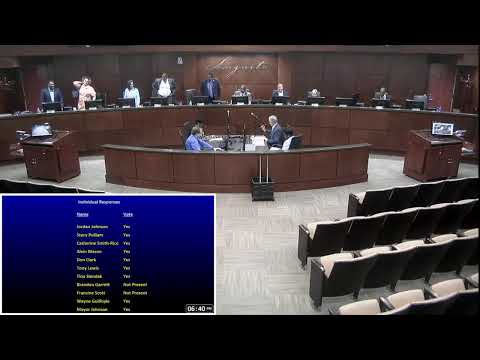
Commissioners voted 6–4 to approve the contract. Commissioners Catherine Smith Rice, Alvin Mason, Don Clark, Tina Slendak, Wayne Guilfoyle and Mayor Johnson voted yes; Commissioners Jordan Johnson, Stacy Pulliam, Tony Lewis and Francine Scott voted no. A substitute motion to postpone the vote until NV5 — the project’s consultant — appeared before the commission failed 4–6.
The contract covers preventive maintenance for the equipment installed in the energy‑efficiency project and extends service to the facilities not fully covered in the project’s original Exhibit G. Interim Director Ron Lampkin told commissioners the maintenance is necessary to preserve the contract’s 20‑year energy‑savings guarantee: “The maintenance contract is renewable every year. If we don't continue forward and the equipment is not properly maintained and then you run the risk of losing your guarantee that was voted on in the contract.”
Why it matters: the original energy‑efficiency project carries a 20‑year performance guarantee tied to measured kilowatt‑hour savings. Lampkin said the contract guarantees 3,816,906 kilowatt‑hours in annual savings; if savings fall short, Trane is contractually obligated to reimburse the city. Commissioners and members of the public pressed for clearer auditing and independent oversight of those savings before approving a $1.16 million maintenance package.
Most of the debate centered on NV5, the consultant retained to review the project and validate savings. Several commissioners and a delegation speaker, Ben Hassan, said NV5 had been asked to appear in January and had not presented to the commission; commissioners argued the consultant should be available to explain how savings will be measured and verified. Lampkin said NV5 has been involved throughout the project and will monitor performance during the contract’s upcoming performance period: “Starting June, we will go into what's called a performance period of the contract, that period is for 1 year, and in that 1 year's time, Trane will monitor, NV5 will monitor, and then they will be reporting back on a monthly basis.”
City administration framed the program’s results as cost avoidance rather than net savings to date. The administrator said the project has helped avoid higher utility costs as Georgia Power rates rose, but cautioned that growing utility prices reduce the program’s immediate dollar savings: “It is more of a cost avoidance, I would say, at this point, than a cost major cost savings.” The administration also noted Georgia Power incentives have been received and may be applied back into the project.
Scope and coverage: Lampkin said the maintenance work covers the 64–65 facilities included in the project, citing the municipal buildings, parks, the jail on Tennessee Road and other sites. He said the aquatic center and some equipment not replaced in the project would be included in the maintenance contract so those systems can be properly serviced in pool season.
Questions and next steps: Commissioners asked for (1) NV5 to present to the commission about performance monitoring and validation, (2) documentation of the consultant contract and recent NV5 reviews, and (3) periodic updates on staffing to build in‑house maintenance capacity. Lampkin said the city is training staff through Trane certification programs that can, over time, reduce scope and cost of outsourced maintenance: the training program is a multimonth process and the maintenance agreement is renewable annually, he said, allowing the city to remove items from the contract as in‑house capacity grows.
Outcome and notable votes: a substitute motion to delay the vote until NV5 appeared failed on a 4–6 roll call. The final motion to approve the Trane service agreement passed 6–4. The clerk recorded the final motion as: “Motion to approve the request for the building automation service and mechanical service agreement 1 year in the total amount of $1,160,670.97 by Trane Company.”
The commission asked staff to provide the NV5 contract and a written schedule for consultant availability and promised monthly performance reports once the performance period begins in June.