Get Full Government Meeting Transcripts, Videos, & Alerts Forever!
Get email alerts on the Seawall Replacement topic
No spam. Unsubscribe anytime.
Punta Gorda Isles committee reviews seawall replacement priorities, timeline
Summary
City maintenance staff updated the Punta Gorda Isles Canal Advisory Committee on seawall replacement priorities, noting shifting rankings after inspections, ongoing work at Swan and Casey Key, and limited barge availability tied to Hurricane Ian recovery.
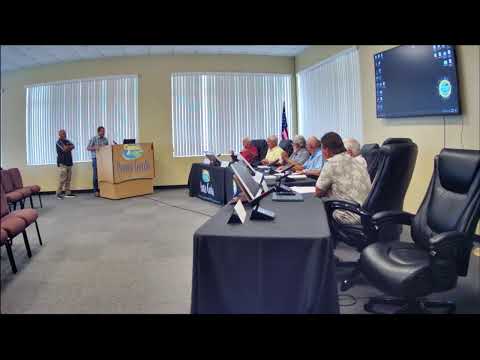
On May 19, 2025, the Punta Gorda Isles Canal Advisory Committee heard a progress report from city maintenance staff on the seawall replacement program, including priority shifts, current field work at Swan and upcoming work at Casey Key and other locations.
The update matters because seawall repairs protect private property and public right-of-way in the island canals, are funded through the district assessment, and must be timed around seasonal weather and contractor capacity.
Mark Storm, maintenance staff for the City of Punta Gorda, told the committee he had visited sites in the last few days and that his team is revising the work order to reflect recent field findings. He said crews are "currently on Swan now, and we're setting panels. So that's going good. We got 3 in the ground." Storm said several sites moved up the priority list after inspectors saw cracking and movement: "We had 1 that came up in the low that progressed up to a to a high, and that's Gulfview. So those 3 are turned into MCG. So we got Darien, Coronado, and Gulfview which are bumping up to the top of the list, so you know."
Committee members discussed how repairs will be scheduled. Jake Dye, a committee member, asked how long the list would take to complete; Storm replied, "All year," and explained that contractors can be given the remaining work and must finish it by the contract end or through renewal next fiscal year. Storm noted contractors have flexibility to reorganize and provide schedules once work is issued.
Storm outlined operational constraints and capacity: "They have 5 barges available, but we only got 1 on maintenance. 4 to focus on the Ian. So that's where that's at." He said contractors could choose to "double up in a bigger zone" after completing other zones and that the program will prioritize walls that show bottom "kick out" or sinkage that threaten structural integrity.
On how condition categories are maintained, Storm explained low-priority walls can remain on the list until they show yard movement or true deflection; in those cases the status is upgraded. "As long as there's no yard movement, no huge... there may be a depression," he said, "it stays at a low until it's...and we're gonna do some attention to general maintenance. We'll go backfill a depression. That's fine. I'm gonna keep it safe as long as we can."
Committee members noted some large projects (Dipper, Casey Key, Osprey) will require extended work and may be staged over time. Storm said he plans to finalize the internal order and post it after wrapping up internal checks and coordination, and he will bring a revised order to a future meeting.
The committee did not take a formal vote on the program at this meeting; the discussion concluded with staff promising updated schedules and further details at the next meeting.