Get Full Government Meeting Transcripts, Videos, & Alerts Forever!
Get email alerts on the Police Accountability topic
No spam. Unsubscribe anytime.
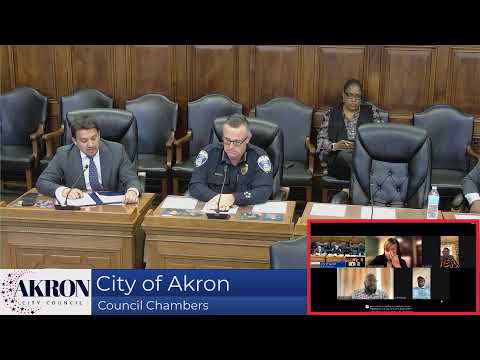
Public Safety Committee delays vote on $350,000 use-of-force review; seeks more time to weigh proposals, University partnership
Summary
The Public Safety Committee took time on a proposal to solicit an outside consultant for a comprehensive Akron Police use-of-force review, authorizing up to $350,000 and requiring the selected vendor to subcontract with the University of Akron Criminal Justice Studies Department.
The Public Safety Committee voted to take time on an ordinance that would authorize the mayor or his designee to award a contract, after a request for proposals, to complete a comprehensive review of Akron Police Department use-of-force policy, training and community engagement practices. The administration proposed a maximum expenditure of $350,000 and said the selected consultant would be required to subcontract with the University of Akron Criminal Justice Studies Department.
Mayor Malik introduced the proposal and said the intent is a broadly accepted review that includes public engagement, data analysis and support for implementation. He said the $350,000 request is lower than a previous $650,000 proposal and reflected more in-house public engagement work and a partnership in which the University of Akron would be subcontracted to provide ongoing support and data analysis.
Chief Harding said goals for the review include assessing whether department policy, training and outreach around use of force are adequate and identifying gaps to be filled collaboratively. He emphasized trust-building between officers and the community and said use-of-force incidents are a small fraction of calls for service but can be consequential for community trust. The chief confirmed that the department averages roughly 135,000 calls for service per year and that reportable uses of force number about 250 to 253 per year (roughly a quarter of 1 percent).
Council members debated whether the work should be done entirely in-house or include outside consultants. Some members said local expertise — including the University of Akron and city staff — should play a central role; others argued that national experts can bring outside perspectives and best practices. Council members also emphasized public engagement and said the RFP and proposals should be made available for review. The administration said it will post the RFP, accept proposals for about a month, and that a realistic completion horizon would likely be six to nine months depending on the proposals received.
After discussion, the committee moved to take time on the ordinance. A roll call on the motion for time recorded four votes in favor and one opposed: McKittrick — Aye; Kammer — Nay; Lombardo — Aye; Hannah — Aye; Davis — Aye. The chair said the matter will return to council after further consideration.