Get Full Government Meeting Transcripts, Videos, & Alerts Forever!
Get email alerts on the Affordable Housing Development Bonus topic
No spam. Unsubscribe anytime.
Tempe considers citywide development-bonus program to create long-term affordable units
Summary
Tempe staff presented a voluntary citywide development-bonus program that would let developers trade added height, density and parking relief for long-term affordable housing units, aligning bonuses with General Plan 2050 objectives.
Tempe staff presented a framework for a citywide development-bonus program that would let developers receive additional residential density, building height and parking relief in exchange for dedicating affordable housing units, staff said. The presentation was made to a joint meeting of the Tempe City Council and the Tempe Development Review Commission.
City planners framed the proposal as a voluntary tool to increase the supply of housing at lower income tiers while aligning with Tempe General Plan 2050. “The development bonus program…is essentially a voluntary process intended to provide a public benefit, i.e. in the form of affordable housing,” said Ryan Levesque, Deputy Director of Planning.
Staff said the program would be applied citywide and administered through a zoning code amendment. Under the draft framework, a property’s “gained” density compared with its underlying zoning would be used to calculate how many of the additional units must be set aside as affordable at specified AMI tiers. Planners discussed multiple affordability tiers tied to AMI ranges and offered example coverage levels for the additional units. Michelle Doleke, principal planner, reminded the group that Arizona law bars mandatory inclusionary zoning but allows incentive programs: “inclusionary zoning is prohibited in Arizona. That’s specifically out of Arizona revised statute section 9 dash 4 61 16,” she said, adding that the state law permits jurisdictions to create bonus incentives.
Staff estimates the program could apply to roughly 7,154 multifamily-zoned properties across about 1,400 acres (a little over 2 square miles) where General Plan densities exceed current zoning, Jacob Payne, principal planner, said. Planners discussed proposed new and adjusted multifamily zones (including a proposed R-6 district) and potential ranges of density and height increases (examples of 40, 60 and 80 feet were shown). The presentation also included scenarios of what rent and owner income differences look like at 80%, 65% and lower AMI levels for a small, hypothetical 20-unit infill project.
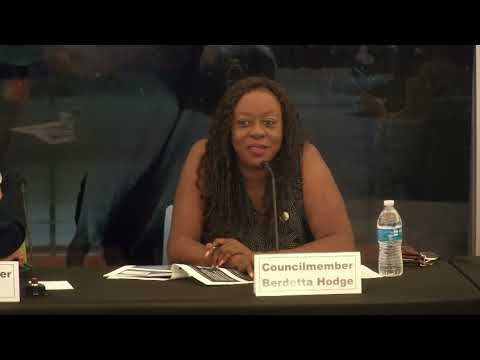
Councilors and commissioners asked for clarifications and raised concerns. Councilor Burrage asked whether projects could accommodate households using HUD housing vouchers; staff replied that vouchers could be included: “It it certainly could,” Levesque said. Vice Mayor Garland welcomed the plan and its alignment with the voter-adopted General Plan 2050 and noted staff’s estimate of 1,417 acres with potential to add density in the city. Councilor Hodge urged that outreach include workers who would benefit most, such as teachers and restaurant staff. Council members pressed staff on the proposed 30-year affordability covenant; staff said 30 years is common for existing incentive programs but that longer terms or perpetuity could be evaluated.
Planners described other existing local programs they expect to work with the bonus tool, including the Hometown For All voluntary contribution program (launched in 2021), the Apache Redevelopment Area incentives (staff estimated about a 20-year history and noted up to 50% development fee rebates for projects that provide 10–15% workforce housing in that area), the accessory dwelling unit ordinance approved late last year and a commercial adaptive-reuse-to-multifamily requirement from state law. Diana Kaminski, principal planner, said the scenarios show how different AMI targets affect what product types households can afford and the revenue differential to a property owner when units are offered at reduced rents.
Staff outlined next steps: prepare a preliminary draft of the ordinance, begin public outreach with stakeholders in late summer, produce illustrative case examples and return to the Council and DRC for a work study session before pursuing formal hearings, with ordinance hearings anticipated late this year into early 2026. No formal vote or ordinance was taken at the meeting; council direction was to continue developing the program and outreach.
Planners noted several implementation details to resolve during drafting: the legal vehicle to guarantee affordability (development agreement or covenant), an annual self-reporting and audit approach to verify compliance, and whether third-party housing administrators should verify household incomes and eligibility. Staff said they will work with the City Attorney’s Office to finalize procedures and legal language.
Tempe officials said the development-bonus program is one of multiple tools to expand housing supply and will be coordinated with voter-approved housing bond funds and other local initiatives.